


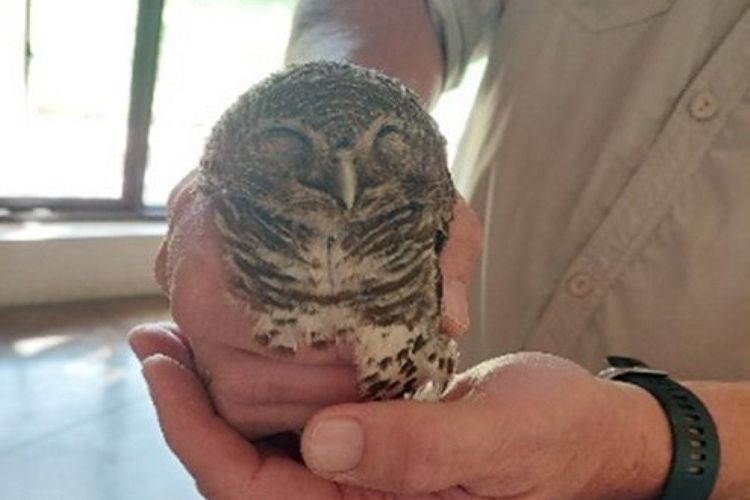
On the 21st of January 2022 an African Barred Owlet was bought into the office.
Members had found this little one next to the road not moving. Moholoholo was contacted and informed that Bungalow #20 was bringing them this little bird. We speculated that it was hit by a car during the night and blinded by the lights. It was unable to recover by itself and needed the help of a rehabilitation centre to recover fully.
The African Barred Owlet is a small owl (20 – 21cm) with a wide distribution in the Southern and Central Africa. They are similar to the Pearl Spotted Owlet and are often misidentified.
In July 2015 there was already a report written on the African Barred Owlet (and can be found here) and I therefore thought it would be rather a good idea to research rehabilitation and share the methods on how to rehabilitate injured animals back into its natural habitat using the African Barred Owlet and its journey as an example.
The goal of wildlife rehabilitation is to provide professional care to sick, injured, and orphaned wild animals so they can ultimately be returned to their natural habitats. Casualties that suffer injuries or illnesses that prevent them from living in the wild are usually euthanized (humanely put to death). Occasionally, individuals that have recovered from their injuries, but are not able to survive in the wild, are placed in education facilities. Wildlife rehabilitation is not an attempt to turn wild animals into pets. Injured wildlife is kept in captivity only until they are able to once again live independently in the wild.
Fear of humans is a necessary survival trait for wild animals, and every effort is made to minimize human contact and prevent the taming of rehabilitation patients. Wildlife rehabilitators work with Veterinarians to assess injuries and diagnose a variety of illnesses. Rehabilitators must be able to administer basic first aid and physical therapy. And, because wild animals are so different from domestic animals, rehabilitators need extensive knowledge about the species in their care, including natural history, nutritional requirements, behavioural issues, and caging considerations. They also need to understand any dangers the animals may present to rehabilitators.
Indeed, as with everything, there are people who would criticize the idea of wildlife rehabilitation, because they believe that nature should be allowed to take its course; that injured and sick animals should be allowed to remain free and let the natural environment choose their fate. However, it should be noted that while that argument is valid, in the majority of cases, it is not "nature" that has caused these animals to be injured, sick, and orphaned.
The leading cause of injury, illness, and orphans among wild animals treated by wildlife rehabilitation is humans. Some may be accidental, others intentional, such as:
- high voltage electrical wires,
- firearms,
- cars,
- trains,
- traps,
- unsupervised children throwing stones,
- clear windows,
- pets,
- poisons and any number of other causes that harm wild animals.,
Wildlife rehabilitation differs from wildlife management in the sense that rehabilitators focus their attention on the survival of individual animals, often without regard to whether it is a member of a rare species. Wildlife management is principally concerned with the health and well-being of wildlife populations and rarely concentrate on individuals. Wildlife rehabilitation could become more integrated with conventional wildlife management in the future, especially when catastrophes threaten endangered species.
Meanwhile, an important role of rehabilitators lies in education. Rehabilitated animals that have lost all fear of humans or that are permanently injured cannot be returned to the wild. Such individuals can be used to teach school children, tourist groups, and our communities about the challenges of wildlife, by bringing rare animals, such as the Ground Hornbill and Blue Crane on display at talks.
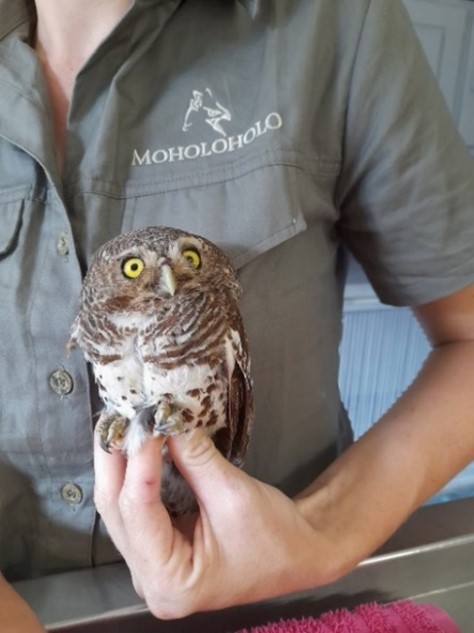
The African Barred Owlet spent less than a month in rehabilitation at Moholoholo. It was extremely lucky to survive a minor incident and only needed antibiotics for the open wounds and concussion.
I collected the Owlet on 15 February 2022, and we released it successfully and safely near the area where it was originally found.
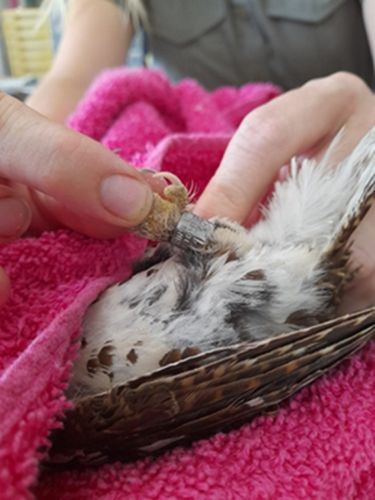
Moholoholo requested Endangered Wildlife Trust (EWT) to ring the bird. It can now be monitored and reported on when found.
NB: We have since seen the Owlet near Bungalow #197 with a partner.

Facts researched on the Internet. Words by Jodine Baard.