


October was a busy month in the UPNR.
With the recent increases of anthrax cases, every possible predator sighting within the UPNR was visited by officials, whether UPNR officials or regional managers, to conduct welfare checks for the potential presence of anthrax in predator populations.
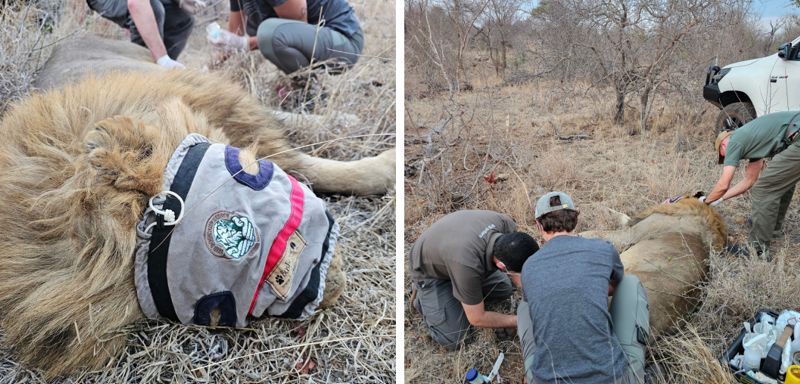
During this time, one male lion with a hanging lower lip and slight swelling on the face was reported at Bird Hide. This male lion was immobilised, tested, and pre-emptively treated for anthrax with the possibility of a positive result in mind. Pre-emptive treatment is given in the form of steroids, multivitamins, minerals and a high dose of Penicillin G to eradicate the anthrax within a few days. Luckily, the test results came back negative, and the lion received a clean bill of health with the injuries likely caused by fights with other lions. We would like to thank Ingwelala Members for their diligence in reporting predator sightings such as this one, and Ingwelala staff for their assistance during the treatment process.
Thank you as well to Wildscapes veterinarian Dr Richard Harvey and his team for their assistance in the swift response and treatment of the male lion.
Following on from this, with the recent rains experienced during the month, the risk of anthrax has dissipated immensely and is now of a lesser concern. The onset of decent rains assists with washing many spores away, thus diluting the concentration of anthrax spores, while also increasing vegetation growth resulting in increased natural barriers to curb the spread of the disease. Rains can be effective against anthrax within as little as twelve hours. As such, it would be quite unusual for any new cases of anthrax to be reported following the recent rains. Despite this, we continue to encourage you to report any suspicious carcasses or predators that show any signs of the disease, as previously infected animals may still succumb to anthrax, and in the interests of overall safety we will continue monitoring as best as we can until the seasonal risk has completely subsided.
As part of our annual game census, predator data is collected via annual call-ups at designated, pre-selected sites across the UPNR, that run from east to west. Four sites were selected, at a minimum of 6km apart, for four call-ups to be conducted. The purpose of these call-ups is to collect data on predator populations, build identification kits and work towards a better understanding of the distribution, density and population data for various predator species. We have a general sense of lion and leopard populations and distributions within the UPNR, but these call-ups are particularly important to assist us with data collection for spotted hyenas, in particular, which can be more difficult to monitor daily. For each call-up, a bait is used, and distress calls are played to assist with attracting hyenas. Each individual is photographed, wherever possible, and counted.
Thus far, two of the call-ups have been conducted in the UPNR. From those call-ups, at least 22 spotted hyenas have been identified. Weather conditions play an important role in the success of a predator call-up, as rain or wind can severely diminish the extent or impact of the call-up. As such, the remaining two call-ups were postponed due to unfavourable conditions, and will be conducted within the first two weeks of November. Importantly, this data must be combined and compared with known predator data - for example, of the sites surveyed, none of the spotted hyenas from the clan denning at Ingwelala responded to the call-ups. Thus, the known denning data will be combined with the call-up data for a better overall understanding of the dynamics, populations, distributions and densities. This is why it is so important to continue to report predator sightings and active den sites.
Further, in terms of leopard and lion monitoring in the UPNR, it is crucial that we gather as much information as possible from every-day sightings. In that sense, the more images, locations and information we can get from Members, the more accurate our data and understanding will be. This information is accumulated into comprehensive identification kits and contributes towards a better overall understanding of all predator distributions, population dynamics, interactions and densities. If you would like to assist with predator data, please send information from any sightings to Tessa. Details to include, wherever possible, are images of the predators, approximate location, date and time (even if just a general road junction or area on a particular day), and anything interesting of note (such as sex, body condition or injuries, or even interactions such as mating, hunting or fighting).
At Ingwelala, you can contact Tessa at
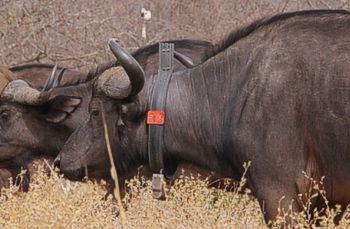
Finally, there have been increased sightings of tagged and/or collared buffaloes in the UPNR.
Out of interest, the tagged buffaloes (and some collared buffaloes) form part of the Kruger National Park’s ongoing long-term research. The UPNR is also part of a new buffalo research project involving the movements, interactions and distributions of large buffalo herds within the APNR, for which new collars were fitted to a bull and cow from each large herd in the area.
This study will contribute towards long-term data involving buffalo herd distributions and dynamics.
Words by Tess Woollgar. Images courtesy of Tess Woollgar & Josh Hibbett.