


During the month, two wild dogs from two different, local packs were successfully collared on the Umbabat PNR, with the assistance of the Endangered Wildlife Trust (EWT).
The first wild dog was collared at the beginning of the month, while the second was collared towards the end of the month.
Although both packs already had a collared dog in each pack, it is important to ensure that more than one dog can be collared in each pack, if possible, to assist with tracking and monitoring, should the pack split or one of the collared dogs becomes incapacitated. It is also vital to try to collar both a male and a female in each pack, as they have different roles within the pack and will disperse from the packs at different ages. Both collars were sponsored by a Member of the UPNR. Collaring of wildlife, especially endangered species, is immensely helpful when needing to find specific animals quickly and efficiently, thus enabling prompt responses to urgent concerns that may arise.
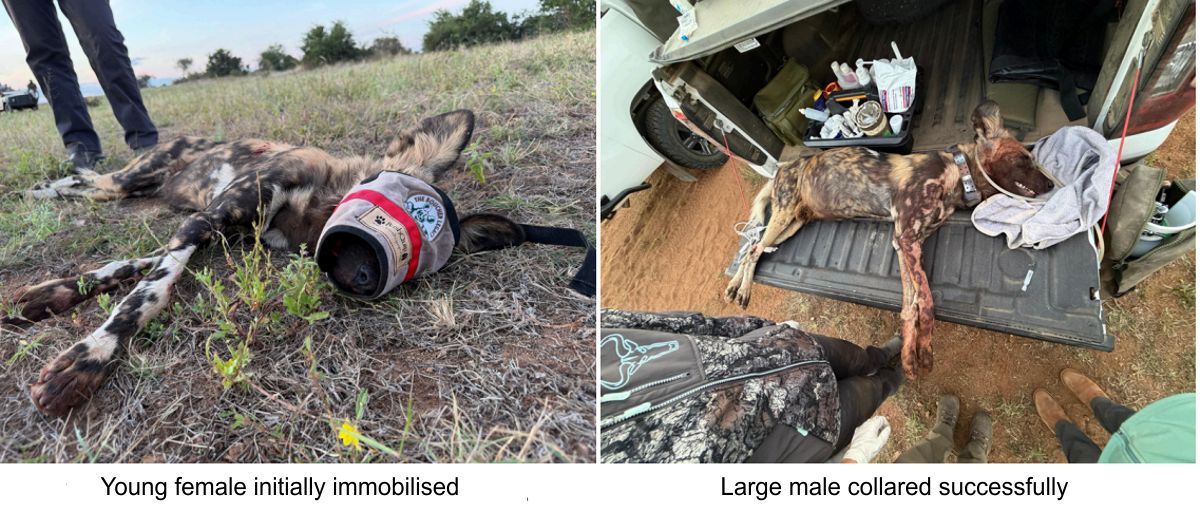
The second pack provided an interesting challenge, as the initial dog identified to be collared was a young female (see image below). However, a second dog - a very large male - was also immobilised when it was noted that there may have been a snare wound on his neck. Luckily, once he had been immobilised, it was discovered that the snare wound was instead a well-healed scar, likely from an old snare wound that has completely healed. Because of the impressive size of this wild dog - the largest anyone in the group had ever seen - it was decided to collar him instead, as the female was still young and may continue to grow in the coming years. We would like to thank all involved in this process.
Out of interest, the locations of the wild dog collars are reflected on the online wildlife monitoring platform used within the UPNR, and each GPS tracking device uploads location data every 3 hours, should signal to the satellites be good enough to do so. This data has proved to be immensely helpful and is one of the reasons both operations were conducted so smoothly this month. By being able to use existing location data from each collared dog within each pack, both packs were found very easily by combining recent collar data with UPNR Member sightings, allowing the operations to be conducted in record time.
All immobilised animals were safely and quickly reunited with their packs.
Words by Tess Woollgar. Images courtesy of Aimee Langenhoven.