


Over the past few years, numerous successful collaring operations have been carried out within the Umbabat PNR (UPNR).
Localised efforts have been focused on collaring African Wild Dogs - an endangered species - because of the critical importance of conserving and protecting this species, and gaining as much insight and information into their movements, populations and interactions as possible.
Due to the nature of wild dogs, being non-territorial, they are known to travel vast distances and, outside of denning times, are not known to spend long expanses of time in the same area. This puts them at risk of being exposed to high-risk areas, and can make it extremely difficult to track or locate them reliably in any given area. As such, the use of GPS collaring devices has proven to be extremely beneficial towards the conservation of endangered species.
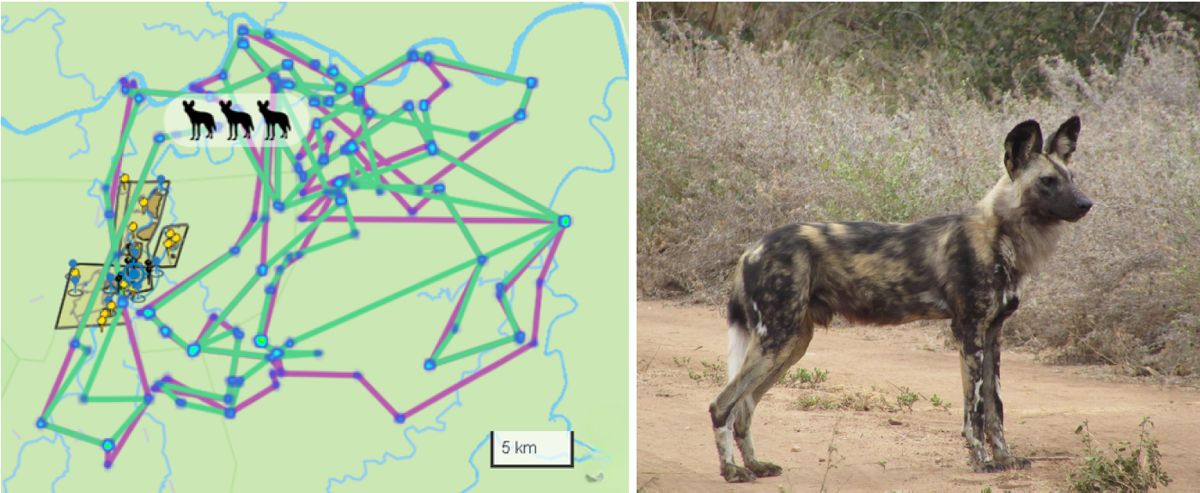
This month, incredible distances were covered by two packs of wild dogs seen regularly in the region. According to the collaring devices of the two collared wild dogs in one of the packs, the pack covered approximately 355km over the course of July (see image below).
This data is accumulated over set time intervals and is dependent on signal strength at the designated times of data uploads. The collars are set to update location data every few hours, but should signal strength not be strong enough (for example, if the animal is in a densely wooded area) the data will not upload, and will instead upload at a later time when signal quality has increased. In this way, the data points represent only the moments when the collars could upload adequately, and shows as straight lines in between those upload points and times.
The distance of 355km is accumulated from following the uploaded locations, but does not account for any movements in-between the uploading periods. During those times, the animals may have moved immense distances, but that movement cannot be accounted for by the collars. As such, the wild dogs may, therefore, have moved a far greater distance than what the collaring data indicates.
Despite this, the overall data obtained gives researchers and conservationists extremely valuable insight into general distribution, movements, and potential interactions or overlaps between different packs, and allows for a more reliable way to locate and monitor the different packs - especially if they need to be found timeously, or in case of emergencies.
Words by Tess Woollgar. Screenshot obtained from EarthRanger; Image courtesy of Aimee Langenhoven