


The use of spotlights to find and see animals at night is a long-standing practice in the bush.
Keying in on the reflective qualities of an animals’ eyes (called eyeshine), spotlighting allows us to detect most animals at night from a distance. As helpful as it is though, spotlighting is also a topic that has caused many debates in the industry as the focus has shifted to caution and sensitivity in recent years, shaping the ethics of spotlighting in the bush as we know it.
We were recently asked a very important question that made us re-ignite the conversation: Should vulnerable animals like wild dogs, rhinos and cheetahs be spotlighted, considering they are protected species? Aimed at the danger we impose on vulnerable species when we completely expose them in the dark, naturally the question brought up a conversation about any potential links between spotlighting of sensitive/vulnerable animals and an increased mortality rate from predators and/or competitors as a result. Is there a link, and are we putting already vulnerable species in a more vulnerable position to have better sightings in the moment? An excellent ethics question that will undoubtedly be a hot topic of debate, so we thought we’d expand on the details and explain the background of spotlighting ethics, and what the known dangers are for animals in any spotlighting situation.
Shining white light into the eyes will temporarily reduce the efficacy of an animals’ night vision, possibly resulting in a decreased ability to forage or find food and simultaneously increasing the risk of predation or competition (i.e. death by predator or competitor). A prime example of this is the white rhinoceros: known for poorer eyesight, and at high competitor risk in males. Although an animal’s eyes will readjust to night vision, the time frame will depend on the intensity of the spotlight and duration of exposure, as well as environmental conditions and the individual animal’s condition. This is even more prevalent when we consider the age of an animal: an animal under three months old has extremely sensitive eyes that are still developing, so a spotlight to the eyes could be devastating and have more severe effects! Similarly, for older animals with failing eyesight, it could be totally debilitating for a far-extended period.
If we further compound this with diurnal versus nocturnal species, or even predator versus prey, we must compare the capabilities and adaptations of each. Diurnal species are more active during the day and as such their eyes are less adjusted for night vision. If spotlighted, this will increase the time frame necessary for recovery, increasing the time when they are more vulnerable or exposed to danger. Compound this further with the addition of vehicles and obstacles in the mix: how does an animal avoid threats, or carry out a hunt, without blindly running into a tree, shrub, vehicle, or another predator, if it cannot see properly? The chances of unintentional injury or death are certainly increased, despite the seemingly absurd probability of such an encounter. It has happened before and can easily happen again.
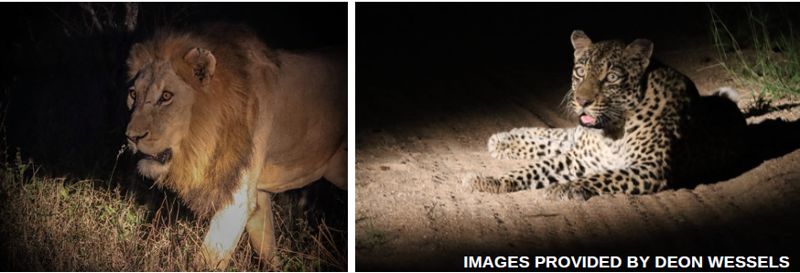
For example, there was a reported incident of an impala running straight into a game viewer while being chased by a predator. This could easily have injured or killed the impala or injured the people in the game viewer! Similarly, it could have ended in the impala being caught when it otherwise may have gotten away, as it stood dazed from the unexpected impact. What remains of utmost importance, regardless of the condition or specifics of the animal or scenario, is that for the period that the spotlight is in any animal’s eyes, and the unique time frame for recovery afterwards, there is undoubtedly a period where the animal is disadvantaged, posing an immediate danger in the affected time frame. The only question is the severity of it, based on each individual animal, encounter and scenario.
What is also important to note, though, is that we are not only affecting their eyesight. When spotlighting an animal, we also completely expose the animal in every way, lighting it up like a beacon in the dark for all in the vicinity to see. In dark conditions, an animal in the spotlight appears in full colour, and very brightly, allowing every other animal to clearly see it and note where it is. This will not only give away the position of the animal almost immediately but can potentially even give clues to physical condition or strength of that animal too (in colour, animals will easily notice a cub previously hidden well in the dark, or even notice the body condition or any injuries on an animal with better clarity). As a result, an animal in the spotlight is immediately disadvantaged in a manner that we cannot undo.
Ultimately, the above reasons are the crux of why spotlighting requires certain ethics and sensitivity, arguably the most important of which include no spotlighting of babies under three months old, and of animals during any active hunt: these are the most serious no-no’s of all spotlighting scenarios. In a similar way, this can be applied to predator interactions as well: competition between predators is fierce, whether of the same species or not, and spotlighting could result in an unfair bias towards either party. Regardless of how sensitive we may think we are being, we will undoubtedly increase the risk to those animals or place an unfair bias on the natural happenings. Often, we do not even realise the immediate dangers surrounding animals until it is too late, and the spotlight has played a role in a severely negative way. Unfortunately, the potential outcomes of unethical or insensitive spotlighting remain the same: unfair bias and a clear disadvantage/advantage, both caused by the actions of people.
Now, if we go back to the important question from earlier: If we take the above information into account, if we spotlight wild dogs or cheetahs, are we disadvantaging them even more because of their endangered/protected/vulnerable status on top of the already risky side of spotlighting an animal in general? Although studies on this are lacking, I believe that we need to take this into account. If we have so few left, and each individual is a crucial part of the surviving population, should we be spotlighting them at all, considering the risk it undoubtedly adds? With vulnerable populations already at risk in day-to-day life in the wild, can we afford to add that extra risk on their behalf, knowing that they are already protected species that are being actively conserved? In my opinion and in all honesty, probably not!
Across the industry, there are varying “rules and regulations” regarding spotlighting of animals. These are company - or reserve-specific in most cases and are varied across the industry. Most account for the basics, while some add on the extra sensitivity of banning the spotlighting of vulnerable or diurnal species as well. In all honesty, it often depends on the possibility of being able to monitor spotlighting practices at all, which is not necessarily a reality in many situations. Pair that with the unpredictability and uniqueness of each scenario, and it can become even more tricky to maintain complete sensitivity in general.
Ultimately, though, I believe it warrants a reminder of our own regulations around spotlighting, and at the very least is a good refresher for when the excitement of a sighting takes over. As we are each responsible for our own actions, we need to be mindful of being ethical and sensitive whenever we can. We ask that you please keep this in mind when you are out on the reserve using a spotlight, and if you can, use the opportunities presented to you to teach others about sensitivity and ethics around spotlighting as well.
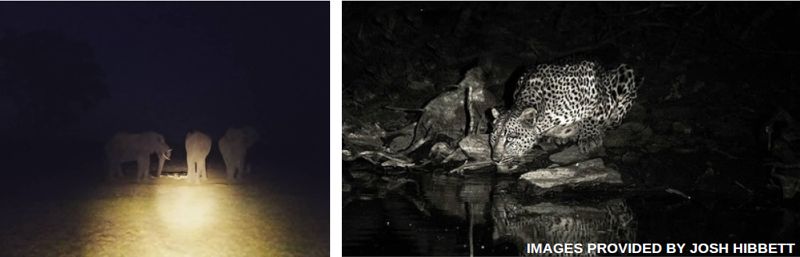
As a reminder, here is a summary of our ethics on spotlighting, as summarised from our “Bush Etiquette” and Gate Letter:
- Please do not shine spotlights in animals' eyes. Shine on the ground in the front of or on the back of the animal. The use of coloured filters on spotlights is encouraged as this is less disruptive to the night vision of the animals and their activities.
- When following predators which appear to be hunting, limit your intrusion so as not to interfere with the animals' hunt. This implies keeping a good distance, avoid shining unfiltered spotlights directly onto the scene and keep all noise including that of the engine, to a minimum. There should be no jockeying for better positions. Once the kill is made, spotlights may be used.
- Our gate letter also includes extra spotlighting sensitivity guidelines for sensitive and diurnal animals like wild dogs.
It is up to each scenario and each person to remain ethical and sensitive when spotlighting. We encourage you to do your best in this regard, and as mentioned above, to teach others the same sensitivity if you’re presented with the opportunity.
If you’d like to chat about this, have any questions or want to share your opinion, please feel free to reach out to us.
Thank you, and happy ethical game viewing!
by Tess Woollgar. Images courtesy of Deon Wessels & Josh Hibbert