


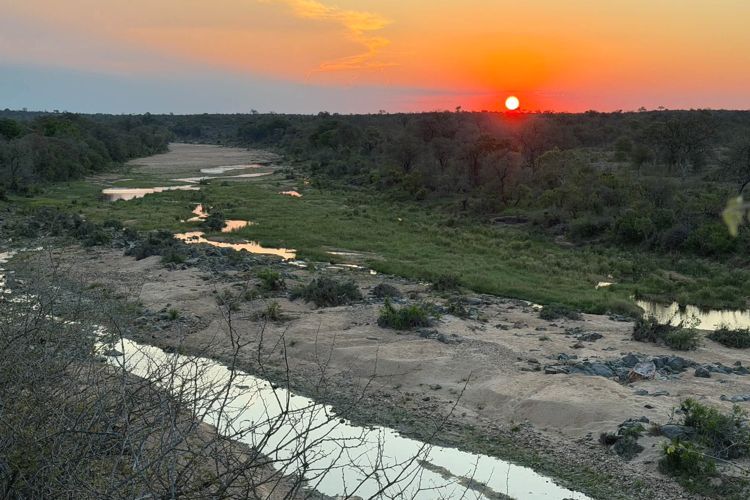
The first month of spring was filled with flushes of fresh greenery, blooms of flowers and the return of various migratory bird species.
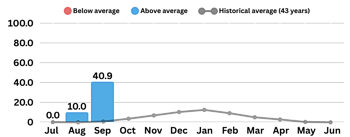
Reserve activities included continued road and river crossing maintenance, electrified fence repairs, fire safety upgrades, and malaria spraying. The annual aerial game census was completed, and maintenance activities and repairs at the conservation office and storage units have concluded. Rainfall was higher-than-average for September, and as a result the veld has begun to turn green. Fresh leaves and grasses have sprouted, and flowers are plentiful on the reserve.
Wind conditions remained unpredictable, and the fire danger index spiked heavily towards the end of the month. Please remain extremely cautious when making any fires and ensure that all fires are adequately extinguished and fully covered with a steel fire drum before leaving them unattended. Please also note any applicable daily fire safety precautions or restrictions when on site and ensure that a suitable fire extinguisher is readily available in your game viewer.
For your interest, a summary of our climactic figures from the month is below.
 Lowest Temp: 10.1°C (Avg: 15.5°C)
Highest Temp: 36.4°C (Avg: 28.2°C)
 Rainfall for the month: 40.9mm
(Avg: 10.4mm)
Year-to-date (July to June): 50.9mm
 Fire Danger Index: VERY DANGEROUS*


*FDI: With exceedingly high biomass and unpredictable wind gusts, the Fire Danger Index is expected to remain high. Please be extremely cautious in this regard!
 Images courtesy of Antoinette Auby
 Images courtesy of Gary MacDonald & Tess Woollgar

Malaria spraying
As is typical for the season, another session of malaria spraying has been completed. Malaria spraying is conducted at all infrastructure on the reserve. This encompasses all Member bungalows, offices, staff accommodations, communal areas, workshop facilities, restrooms, bomas, hides and viewing sites.
This form of treatment is conducted as a malaria control strategy across malaria-endemic areas within Africa. This method is recommended by the World Health Organisation (WHO) and is particularly effective when completed in high coverage. Indoor and outdoor surfaces should be sprayed where mosquitoes are prevalent. Designed to assist with the control of the population of mosquitoes and provide an opportunity to reduce the possible transmission of malaria, this method can remain effective against mosquitoes for months at a time and is most effective when conducted before peak mosquito breeding seasons.
During this treatment process, strategic areas of all infrastructure are sprayed, with emphasis on the areas mosquitoes are most likely to land between feeds, or where they are likely to enter buildings, and is particularly effective when porous materials or surfaces can be treated (e.g. wood and thatching grass). Generally, the areas targeted for spraying include windowsills, roofing, eaves, outdoor storage areas, walls, braai areas, bomas and any dark corners - however, this varies for each unique building or structure. When high or complete coverage has been achieved, it has been proven to notably reduce incidents of malaria in malaria-endemic regions.
We thank you for your cooperation as this vital treatment is conducted throughout the year.
Road and river crossing maintenance
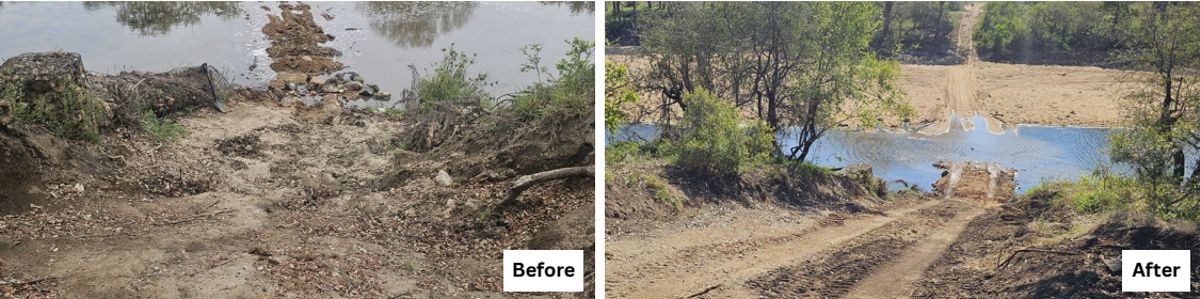
Throughout the year, road and river crossing repairs have been ongoing. Although continued rainfall, still-flowing rivers and the residual high water table have presented challenges throughout, all roads and river crossings have been successfully re-opened for traverse. While there are more substantial repairs scheduled in certain areas - especially select river crossings where infrastructure was washed away - all roads and crossings are currently traversable.
The conditions of all roads and river crossings continue to be monitored, and spot repairs are conducted as and when necessary, as is the norm for any dirt tracks. Please continue to make use of 4X4 low range when making use of any river crossings, as river crossings remain saturated and soft. This is particularly important when making use of the more sensitive inclines/banks on either side, and in any wet patches in the crossing. We thank you for your continued care and cooperation in this regard, assisting with reducing the frequency and intensity of erosion in those sensitive areas.
 Images courtesy of Josh Hibbett
Conservation interns’ projects
The conservation interns have been very busy this year, with projects spanning various scopes within conservation. Their projects have included veld rehabilitation and management, veld condition assessments, administration, animal monitoring and studies, electric fence maintenance, malaria control, road and river crossing maintenance, water conservation and reticulation, invasive plant control, airfield maintenance, historical sightings comparisons, and conservation awareness and education, amongst others.
The interns would like to thank all Members who have contributed rare species sightings and hyena sightings towards their various animal studies projects. The data collected has been very helpful. As part of these species-specific studies, throughout the year multiple trail cameras were set up across the reserve, monitoring for activity of hyenas, aardvarks and other rare species. Trail cameras were placed in multiple areas, including on major game paths, at popular water points, and at active burrows, looking for any interesting activity.
The trail camera data has shown that although there may be fresh tracks and signs of animals such as aardvarks, and even sightings, they are immensely difficult to capture on trail cameras. However, footage of animals such as African Wild Cats, Honey Badgers, hyenas, genets, porcupines and jackals, amongst others, has been plentiful, and has given a good indication of the areas and time frames during which these animals may be more active.
The interns’ projects will continue until December. Should you still wish to submit information or photographs of hyena or aardvark sightings, please email
Fire safety
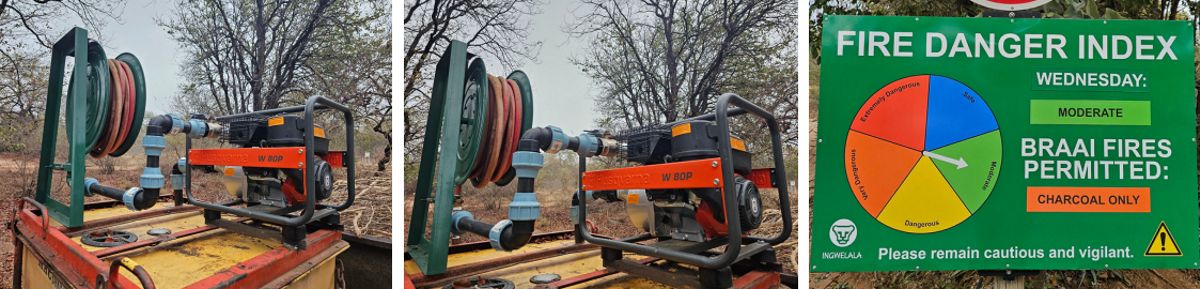
Although the veld has begun to turn green, biomass remains extremely high, and fire safety remains at the forefront of all activities. As part of the continued focus on fire safety and preparedness, the responding firefighting “bakkie sakkie” was upgraded to include a new hose reel and upgraded pump. These upgrades have made this vital first-response equipment more powerful and efficient when in use.
With vegetation beginning to grow rapidly, please be mindful that cleared biomass immediately surrounding infrastructure will grow back quickly and may require further follow-up clearing. Should you feel that further clearing may be required at your bungalow, please contact reception to make arrangements. Please also be mindful of radio updates and pertinent daily fire safety information displayed on the fire danger index signage at the entrance gate, which displays daily fire safety information and braai fire restrictions. Thank you for your cooperation.
 Images courtesy of Tess Woollgar.
Electric fence maintenance: Giraffe incursion
During the month, an adult giraffe was witnessed running towards and breaking through the electrified fence, entering the camp and causing extensive damage to the fence line near Wahlberg’s Gate. It is believed that the giraffe was frightened or being chased by something and broke through accidentally.
Although this is a rare occurrence, when they do occur, giraffe incursions often cause the most damage to electrified fences, as giraffes tend to continue running through impacts, as opposed to turning back, as many other species would when a barrier is encountered. Luckily, the giraffe exited on its own shortly thereafter, physically unharmed, and the team could repair the fence immediately after the Member’s report of the incident occurring.
Revamp completed at the conservation office and storage units
Repairs and maintenance at the conservation office and Member-available storage units have been completed, and the conservation block is once again open and fully functional. Operations included the fitment of new, durable roofing, general infrastructural maintenance, and full internal and external re-painting. Thank you to all who made this possible.
All storage units are once again available, should space be required for the storage of household items while your bungalow is undergoing any approved refurbishments, construction or maintenance. Should you wish to enquire about storage unit availability or bookings, please contact reception or the conservation team directly, at
We apologise for any inconvenience caused while the rentable storage units were temporarily unavailable during this period, and are excited to welcome new bookings.
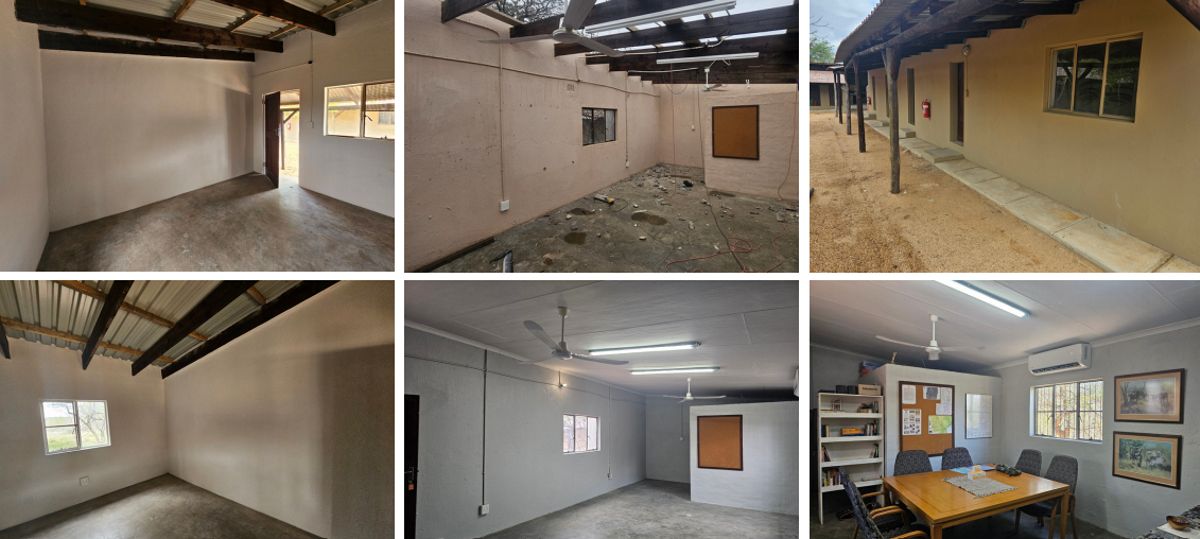 Images courtesy of Tess Woollgar

Staff member of the month
The staff member of the month for September is Amelia Mahlalele.
Amelia is a dedicated member of the workshop department and had an incredibly busy month preparing plenty of Member vehicles and assisting Members and staff at the forecourt and fuel station.
In the busy periods, the workshop has plenty to do - and Amelia was dedicated and consistent in her efforts throughout.
Thank you, Amelia, for all you do! We appreciate you.
Notes from the conservation team
Fire safety and awareness:
Please be reminded of general fire safety and awareness as the veld begins to thicken once again. Although veld conditions are beginning to turn green, and there is plentiful surface water availability, the fire danger index remains high and extreme caution is advised, as fires can still spread incredibly quickly in these conditions. This is particularly important considering the unpredictable wind gusts experienced and higher-than-average biomass available this year.
Please ensure that all fires are adequately extinguished and fully covered with a steel fire drum before leaving them unattended. Please also ensure that you stay informed of daily fire safety precautions as displayed on the fire danger index sign at the entrance gate and adhere to any daily braai fire restrictions that may be in place. Please also ensure that an appropriate fire extinguisher is readily available in your game viewer. Any signs of smoke or a fire must please be reported immediately.
Reporting of invasive plants and trees over the roads:
Thank you for your continued assistance in reporting invasive plants and any trees over roads that require removal by the team. These reports go a long way in assisting the team to manage these concerns timeously, and are greatly appreciated. Please do not hesitate to contact the team, or reception, via radio to report any further concerns.
Bush walks:
We would like to thank all Members who have joined bush walks with the trails team this year! Walks have been immensely popular, and sightings have been truly spectacular. We sincerely hope you have enjoyed every step taken, and hope to take you on another bush walk soonest! Please be advised that bush walks will not be available during November, as the team will be unavailable and off-site. We thank you for your understanding in this regard.
Building Projects
John Llewellyn, represents the Building Committee at reserve level regarding all building related issues to members bungalows. Members are welcome to call Reception ahead of their visits to enquire what building related disturbances may be encountered in the vicinity of their bungalows.

Current building projects are listed below:
- #16: Thatch repairs.
- #81: Internal renovations.
- #125: Comb and patch thatching.
- #139: Demolish and rebuild.
- #178: Internal renovations.
- #196: Thatch repairs.
- #207: Re-thatch and internal renovations.
Words by Tess Woollgar. Images courtesy of Maureen Kirk, and as noted on individual photos or sets of photos.