


Another busy month has come and gone in 2026. As we move further into winter, priorities shifted to essential preparations for the upcoming dry season.
Manual firebreak clearing around all infrastructure was a key focus, with many bungalows having been serviced throughout the month. A long service awards ceremony was held on site following a successful board meeting, and select staff received first aid training on site.
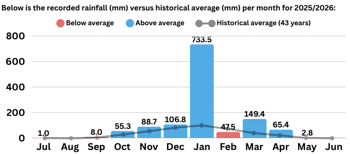
Continued efforts on the reserve included road, river crossing, electric fencing, and airfield maintenance. Snake relocations were once again a regular occurrence, and caution is advised. Overall weather conditions have stabilised, with cooler overall temperatures, very little wind, and low humidity, as well as very little recorded rainfall.
As the veld has begun to dry out, the Fire Danger Index increased from “Safe” to “Dangerous” as the month progressed. Please remain vigilant and cautious as the dry season approaches.
For your interest, a summary of our climactic figures from the month is below.
 Lowest Temp: 7.5°C (Avg: 13.2°C)
Highest Temp: 32.8°C (Avg: 27.7°C)
 Rainfall for the month: 2.8mm
(Avg: 27.2mm)
Year-to-date (July to June): 1258.0mm
 Fire Danger Index: Dangerous*


*FDI: With exceedingly high biomass and unpredictable wind gusts, the Fire Danger Index is expected to increase as the veld dries. Please be extremely cautious in this regard!
Manual firebreak clearing
Of primary focus is fire risk mitigation and the manual clearing of firebreaks around all infrastructure. This incorporates managing fire risk in camp, around each bungalow and building, and on the reserve around the camp perimeter, on each boundary, and at each boma, hide, viewing site, and designated fire-making site.
Many bungalows have been serviced, with efforts focused on thinning out biomass and vegetation as much as possible following the wet season. All fire risk mitigation activities are conducted according to perceived risk level, and as such will be serviced in alignment with that. Fire risk mitigation will continue to be of primary focus in the coming months, and may require repeated mitigation, if necessary - particularly if continued vegetation growth is noted.
At this stage, rainfall is subsiding and there are indications of approaching drought conditions. We encourage extreme caution in this regard and thank you for your co-operation.

Interesting plant: African Horned Melon
In the aftermath of the flooding, some unusual sightings, species, and changes have been noted. This is expected, considering the enormous change in climatic conditions of late, and is particularly evident with changes in vegetation, insects, spiders, amphibians, migratory birds and “uncommon” species seen.
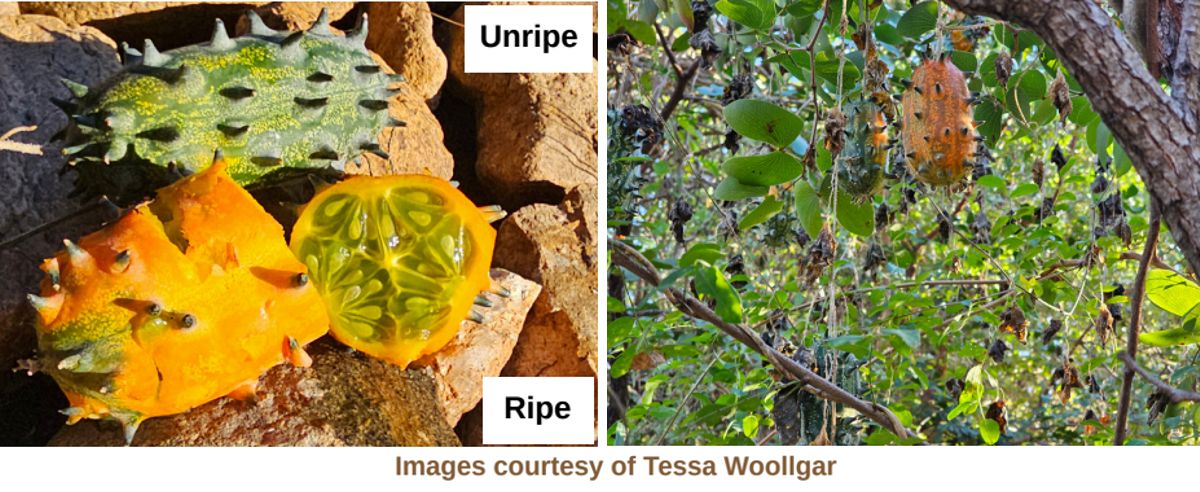
One of the more interesting changes in vegetation has been the mass emergence of an indigenous vine known as the African Horned Melon, Jelly Melon or African Horned Cucumber (Cucumis metuliferus). This species is being noted in extremely high densities following the flooding, particularly along river courses and in camp.
Growing on grasses, trees and shrubs, this plant is most noticeable when the fruits emerge and hang below the plant. When ripe, the fruits become bright orange and smell just like a mix of cucumber and melon! Although high in vitamins, and edible, especially to monkeys, baboons and antelopes, the fruit is extremely bitter to eat and can be toxic if eaten raw in high quantities. Cultural methods employ cooking to dispel toxins and remove the lingering bitter taste.
Snake relocations and sightings
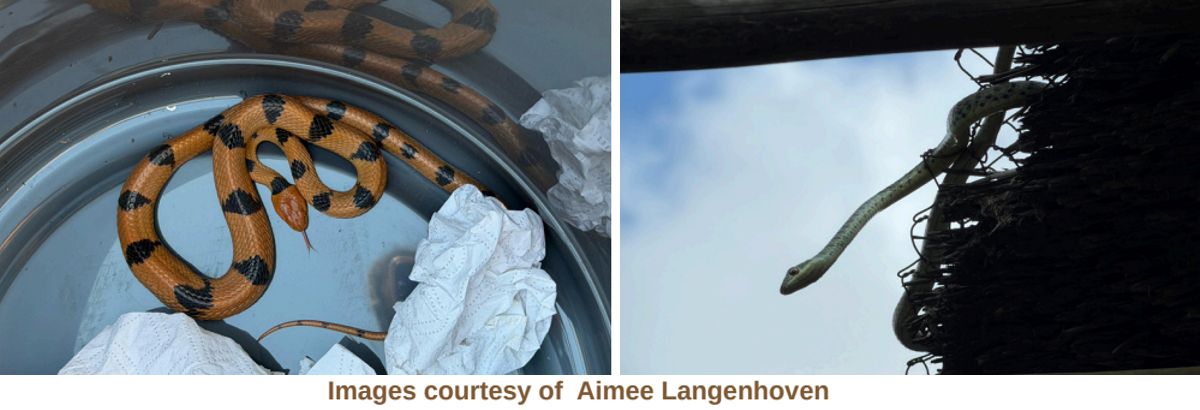
Callouts for snake removals and relocations were once again regular throughout the month. Species relocated included Puffadder, Spotted Bush Snake, Eastern Tiger Snake, Black-headed Centipede-eater, Eastern Bark Snake, Mozambique Spitting Cobra, Stiletto Snake, and Black Mamba.
There has been a notable increase in snake and scorpion sightings recently. Of particular importance is where they have been located at or within bungalows. Most snakes were relocated from within bungalows, particularly from thatched roofing, underneath furniture, in outdoor facilities, and within indoor and outdoor cupboards!
Please use extreme caution in this regard, as snakes, scorpions and spiders are more likely to be seeking shelter near or within infrastructure as temperatures continue to decrease.
Please do not hesitate to call should you need assistance with relocating snakes or scorpions!
Thatched roofing maintenance
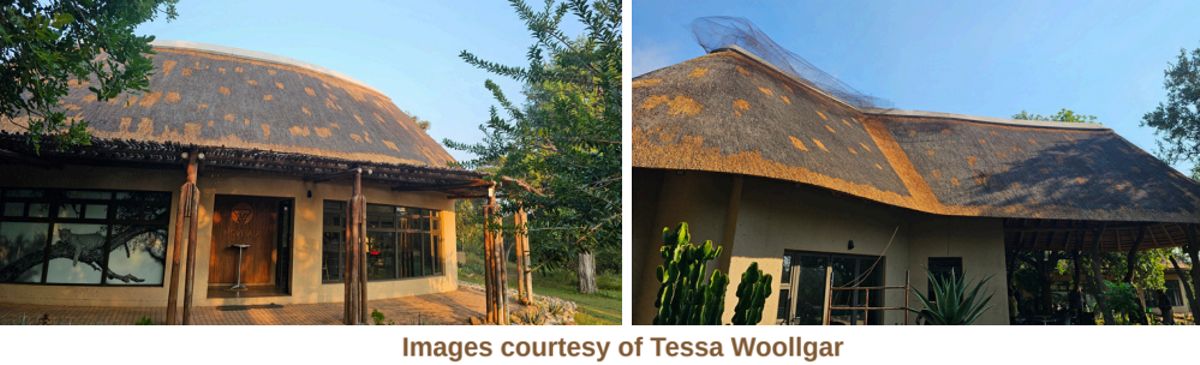
Throughout the month, continued maintenance and upkeep of infrastructure have been ongoing. Various buildings in camp have undergone routine patch and comb work on the thatched roofing during May.
Thus far, infrastructure serviced during the month includes Guineafowl Cottage, the laundry, the swimming pool restrooms, the reception building, the Ingwelala shop, the back-of-house offices and the Members’ Area main facility. Although there are still finishing touches to be undertaken in some areas, this is not expected to take long and should be complete within a matter of days.
Although this process can cause a bit of dust and debris while underway, this routine maintenance is crucial for overall longevity, and we thank you for your patience and understanding in this regard.
Thank you for your assistance!
Invasive plant control continued
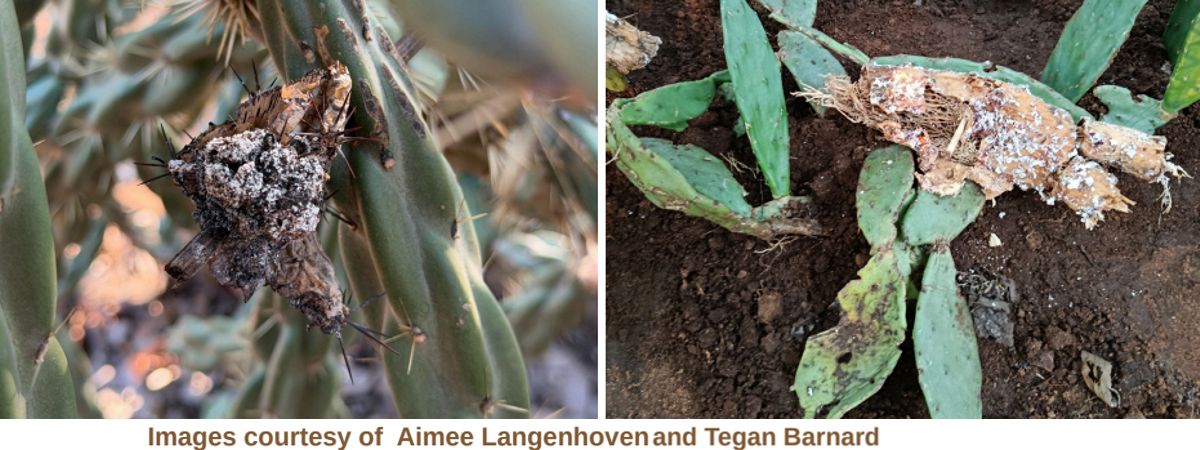
Steady progress is reported with the treatment and control of invasive plant species such as Prickly Pear (Opuntia spp.) and Rope Cactus (Harrisia spp.) in camp and on the reserve. Another session of treatment using biocontrol agents is underway, with various plants having been treated during the month.
Additionally, many small invasive cacti were removed and are being used to establish a controlled sustainable stock of biocontrol agents on site. This will assist with having more biocontrol agents readily available for the treatment of any new plants reported in the future, while reducing the need to re-visit treated plants, and avoid removing excess biocontrol stock from those plants – further improving success.
This project is being co-ordinated by the conservation interns, who are stocking the containment area. From this stock, cacti on the reserve are being treated as and when reported or discovered. Please continue to report any invasive plant species, with accurate location details. If you are unsure whether a species is invasive, please report it for the team to identify and treat, if necessary.

Staff members of the month
The staff member of the month for May 2026 is Difference Mokoena. Difference is a dedicated member of the conservation team and has spent the month doing a diverse range of activities and tasks, from manual firebreak clearing and working magic in the beautiful gardens, to repairing river crossings and roads, and everything in-between!
Difference is incredibly diverse in his skill sets and is always ready to assist with any task - whether big or small. You will always see Difference with a smile on his face, a word of encouragement at the ready, and a joke waiting to be shared with the team.
Thank you, Difference, for your unwavering positivity, dedication and passion.
Interns’ insights
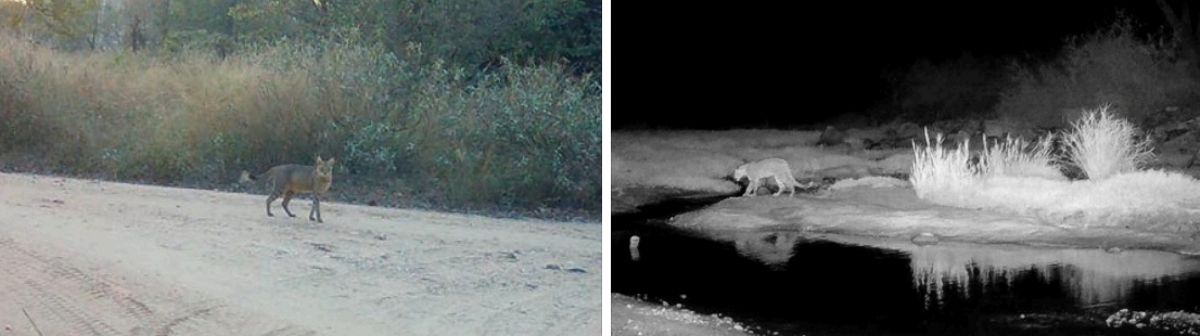
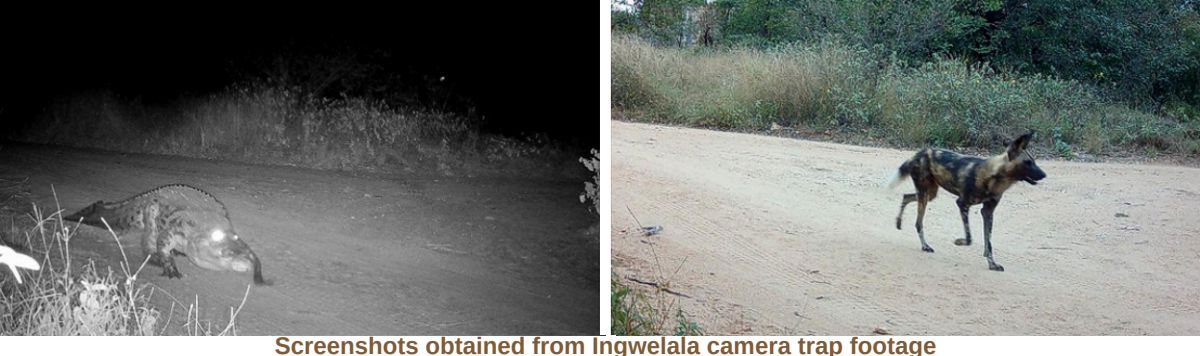
During the month, the conservation interns captured a wide variety of interesting sightings on camera traps. They have immensely enjoyed this project, which is still underway, but wanted to share their favourite highlights. Please enjoy the screenshots below, taken from camera trap footage. Highlights included a large crocodile, a pack of wild dogs and a wild cat walking through the same intersection in camp, and a leopard in the riverbed at Aloe Ridge.
Building Projects
John Llewellyn, represents the Building Committee at reserve level regarding all building related issues to members bungalows. Members are welcome to call Reception ahead of their visits to enquire what building related disturbances may be encountered in the vicinity of their bungalows.
Current (major) building projects are listed below:

- #7: Patio tiles relaid. External paint.
- #24: New stand-alone gazebo on existing patio.
- #87: Refurbish outside shower and door replacement.
- #139: Demolish and rebuild.
- #157: Internal alterations.
- #207: Re-thatch and internal renovations.
Words by Tess Woollgar. Images courtesy of Tess Woollgar, and as noted on individual photos.