


Following on from the January flooding, this month has been dedicated to re-opening the reserve and further assessing and repairing damage.
Special focus was placed on roads, water reticulation, electric fencing and infrastructure. Although flood damage repairs are a mammoth task, the team has achieved an impressive amount in a short space of time, and we are proud of all that has been achieved thus far. There is still plenty of work to do, on a priority basis.
The team and Members also got to experience the safe removal and relocation of elephant bulls during the month, three of which were encouraged out on their own, and two of which were safely immobilised and relocated within the Umbabat PNR. Throughout the month, Members enjoyed more and more traverse, while the overnighting bomas were re-opened and the moratorium on night driving was removed.
With rivers still actively flowing, and plenty of surface water availability, humidity was at an all-time high throughout the month. Please see the below climactic information for the month.
For your interest, a summary of our climactic figures from the month is below.
 Lowest Temp: 16.1°C (Avg: 21.3°C)
Highest Temp: 39.0°C (Avg: 32.9°C)
 Rainfall for the month: 45.7mm
(Avg: 78.3mm)
Year-to-date (July to June): 1040.4mm

 Fire Danger Index: Dangerous*


*FDI: With exceedingly high biomass following the heavy rains, and unpredictable wind gusts, the Fire Danger Index remains high despite the green veld conditions. Please remain cautious.
Road repairs
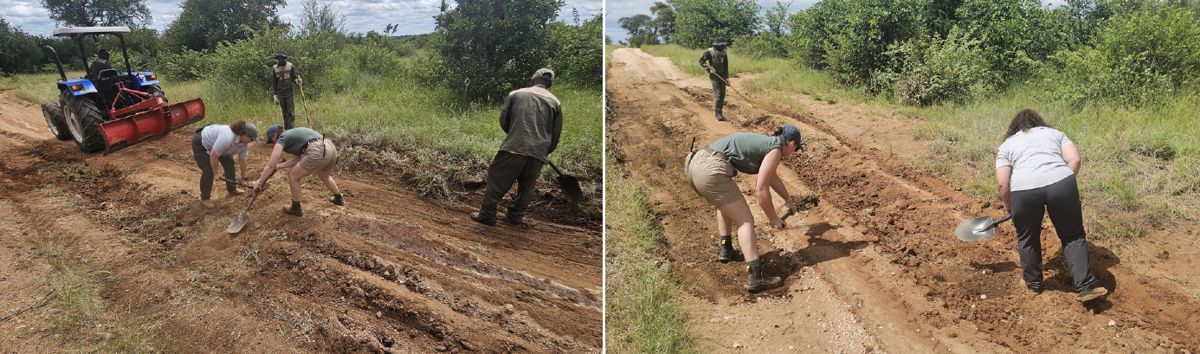
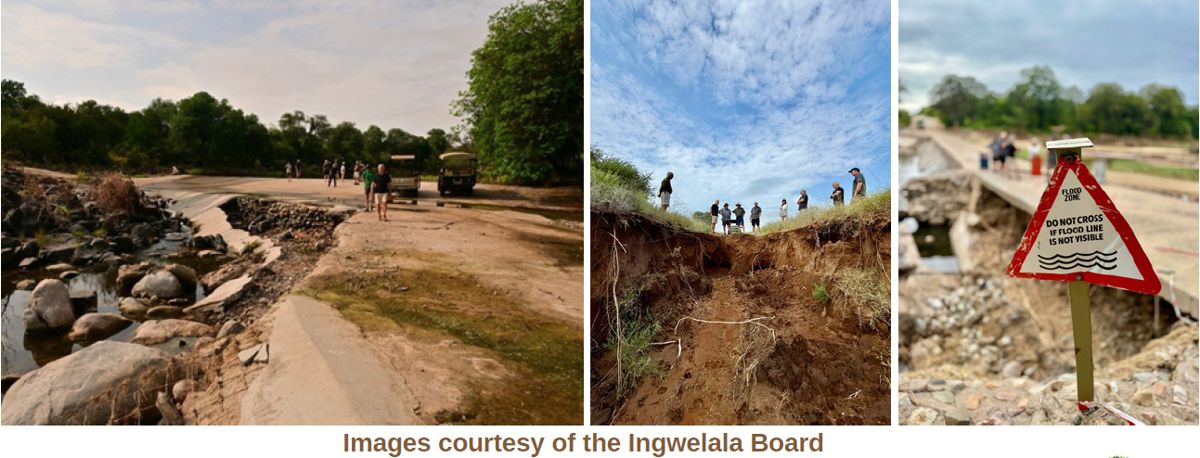
The flooding event experienced caused widespread and catastrophic damage to road networks and river crossings on the reserve and in camp. We are proud to have re-opened the vast majority of roads on Ingwelala, with extensive repairs carried out on both sides of the N’hlaralumi River, thanks to a wonderful team dedicated to road repairs.
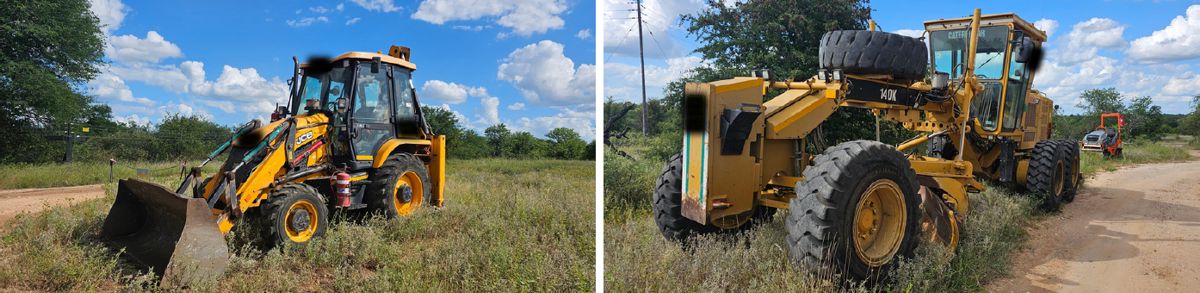
We are immensely grateful for the immediate offers of assistance from Peter Dittberner (#10-13), Wolfgang Neff (#50) and the incredible WHBO team. Their remarkable assistance with Ingwelala’s road restoration project following the floods has been undeniable. Earth-moving, heavy machinery in the forms of an industrial grader, compacting roller and TLB, have been on site for the month, consistently working to repair and restore our roads.
Thanks to their generosity, care and kindness, more than 80% of our roads have been serviced. Without their team’s dedicated work, our team would not be able to continue with other vital tasks, and we would not be progressing nearly as well or as quickly. The enormous difference they have made is remarkable, and we are progressing so well thanks to their use of heavy machinery. Thank you so, so much!
To highlight the extent of the road damage and current saturation levels, especially with continuous flow at all seep lines and drainage lines, the industrial grader had three incidents during which it sank deeply into the road, all on Argyle, which required the TLB, tractors, chains and rocks to resurrect. With amazing team effort from the WBHO crew and the conservation team, the grader was successfully uplifted to continue working. However, two of those sections of Argyle remain closed for traverse until the roads have dried out sufficiently for final repairs to be conducted and safe passage to be allowed!

Although the team has achieved a truly unprecedented rate of repair at Ingwelala, with the priority-based repairs, there are roads open for traverse which have yet to be serviced, as their condition is deemed “good enough to use with caution”. As such, there are roads that are traversable which still require caution, as they are eroded and may be bumpy. Please take care on these roads, which are visibly ungraded currently. Please also bear in mind that the vegetation has grown at an unprecedented rate during this time of extended rainfall. As such, the “middle-mannetjie” on non-serviced roads, and the vegetation on some road verges, may be very overgrown. We encourage that a fire extinguisher must be present in each vehicle.
Further, we have had many queries of how Members can assist us on the reserve. Should you wish to assist with the trimming of vegetation on the traversable road verges, there are hand tools available at the Ingwelala entrance gate which can be taken out onto the reserve during your drive if you’d like to be “hands-on”, at your own risk. Your assistance in this regard will go a long way, as the team focuses on other urgent priorities following the flooding.
As soon as is possible, the few outstanding roads that are open for traverse and that have not yet been serviced will be seen to, to make them more comfortable and stable. River crossings remain closed, and as soon as servicing of the roads has been completed, the banks of the river crossings will be serviced so that they are accessible as soon as the riverbeds have dried out enough for safe passage.
We thank you for your understanding and patience in this regard and wish you happy game viewing with the newly opened and serviced roads!
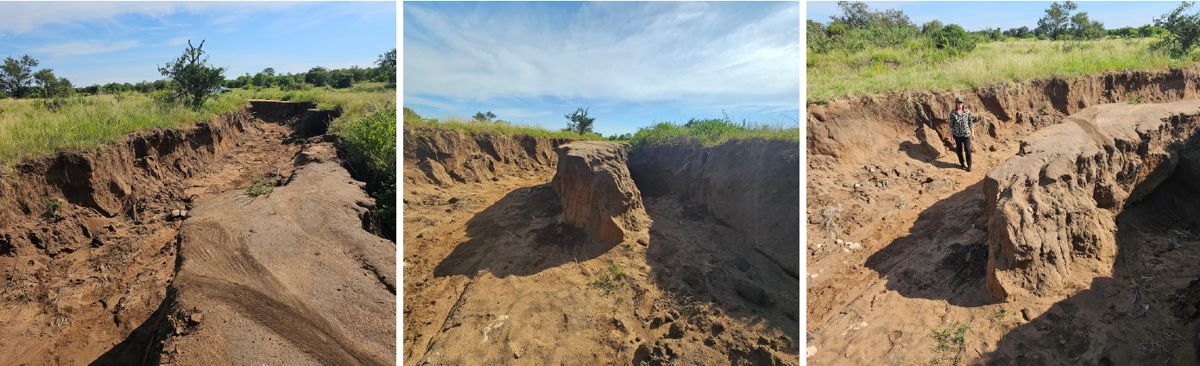 Mermaid Crossing (western bank)
 Sibon camp’s entrance road from the tar road
Traversing update
With the impressive rate of road repairs, it is now easier to summarise the closed roads - marking a very happy turning point for Ingwelala - and which would not have been possible so quickly without the assistance of WHBO, Peter Dittberner and Wolfgang Neff. Again, we are extremely grateful for the generosity and assistance in this regard!
Following on from the extensive road repairs already carried out, we are proud to say that most of our roads are open for traversing. Please collect an updated map at the Ingwelala gate when you arrive, which indicates closed roads on the reserve, as highlighted on the map. Updates and additions are announced via radio announcement in the mornings, and Reception has an updated map and highlighters/marker pens should you wish to make edits to your existing map received upon entry. Updated maps will also be posted on the official communication groups and social media pages.
Please also take care when traversing to look out for barricades in the form of logs, rocks, danger tape, reflective tape, steel cabling, or any combination of the above, indicating closed roads on the reserve. Should the team be working on roads in an area, they may temporarily move barricades while working, so please check on your map if a barricade is not complete and avoid any highlighted portions or roads.
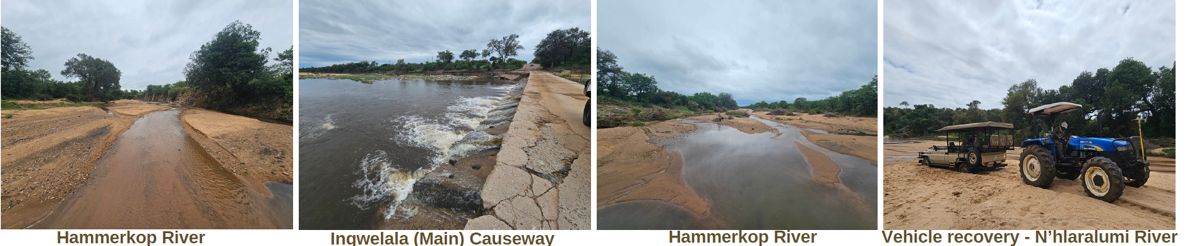
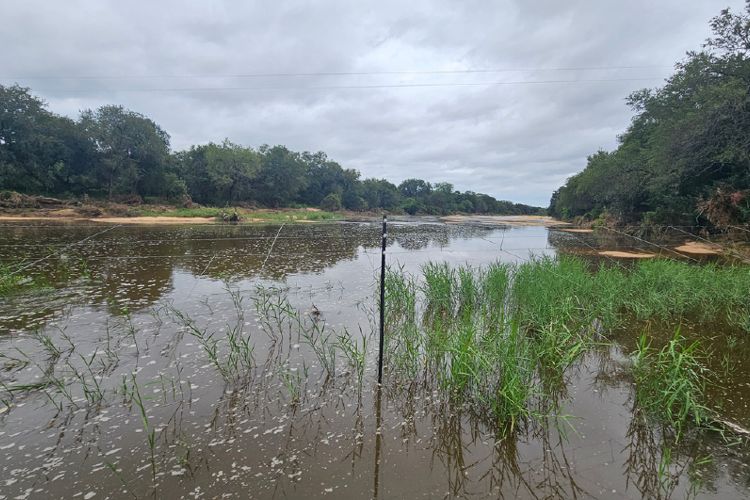
Please note that although most of the roads are open, all river crossings remain closed. This is simply due to the extremely high water table, and all rivers still being fully saturated. Further rainfall throughout this period has resulted in no decrease to the water table, and as such, any weight on the sand results in a very quick sinking feeling, and the need for heavy-duty recovery. If you wish to enjoy views in the riverbeds, we instead recommend parking near the bank of the crossing where some of the river may be viewable.
Although temporary repairs with the TLB are being and have been carried out at certain sites, and on riverbanks at river crossings, the riverbeds themselves are not yet crossable and remain volatile. As such, the only way forward is to wait until the riverbeds are dry enough for safe access. We cannot give an estimate as to when the rivers will be dry enough to hold the weight of vehicles, so at this stage riverbeds are only accessible on foot, at your own risk.
We thank you for your patience and understanding in this regard.
Electric fencing around the camp
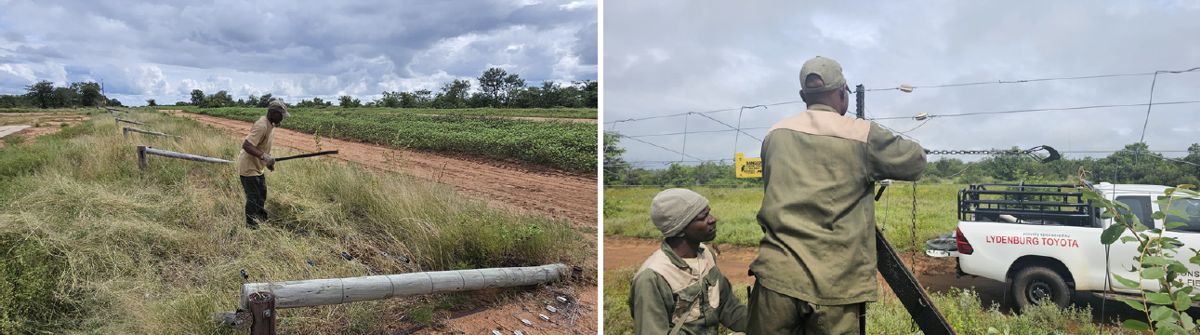
Following on from the incredible efforts to safely remove five elephant bulls from the camp, the team has been hard at work installing the more permanent electric fencing at all river crossings. This has been a mammoth task, as all river crossings sustained severe damage and required completely new installations, with most of the fencing materials not recoverable or too severely damaged to be re-used in the reinstallation process.
Considering the presence of the five elephant bulls in camp, the initial decision was made to install a temporary, two-strand fence at the river crossings, that could be easily constructed and deconstructed, when needed, to allow safe passage for the elephants to exit when encouraged to do so, while also preventing any further elephants from entering the camp in the interim. This design enabled the team to respond quickly when the opportunities presented themselves for the elephants to be encouraged out at the river crossings. This strategy worked phenomenally well, allowing the team to be able to adapt quickly in deconstructing and re-instating fencing at any of the three river crossings, while also allowing an adaptable approach on the ground with multiple accessible options for the safe and unhindered exits of the bulls.
Although the temporary electric fencing was effective for the interim period when it was necessary, it was vital that the more permanent fencing designs be installed as soon as was possible. Construction began as soon as the last bull was safely relocated out of the camp, with the team standing by and ready to begin as soon as the loaded truck had left the premises. Installation of the fencing was completed over a period of three days, during which the team removed the temporary fencing and fully replaced those sections with new steel Y-standards, four-strand electrified steel wire and elephant spikes.
A hearty thanks goes out to the conservation and maintenance teams for their efforts in this regard. Many hours were spent constructing, de-constructing and repairing the fence after these unforeseen challenges and circumstances, and the team did a fantastic job of adapting, problem-solving and quick-thinking during this time. This was particularly pertinent during those times where the elephants were being encouraged out of camp, during which the team would deconstruct and reconstruct the temporary fences over multiple days as efforts to safely encourage the elephants out continued.
February Board Meeting
The board meeting this month went phenomenally well, with good progress made on all fronts. This was particularly pertinent for flood damage and the work that will be necessary to restore Ingwelala to its magical state over the coming months. The Board was able to do site and damage assessments with John, going on a field trip on the reserve to various areas that have been the most damaged by the January floods.
We would like to thank our dedicated Board Members for their continual support, effort and dedication to Ingwelala, and for giving of their time so unselfishly both daily and throughout the flooding period, especially. A special thanks as well to Willichia and the team that assisted with logistics for this event.
Conservation donation: tree protection
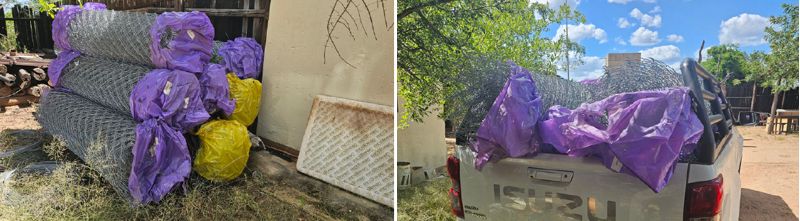
We would like to thank Freddie Ratzlaff (#101) for his generous donation of multiple rolls of heavy-duty steel wire for additional tree protection at Ingwelala.
Tree protection, in the form of tree wrapping, is an important aspect of Ingwelala’s efforts to reduce elephant damage to trees on the reserve, particularly focusing on protected tree species such as Marula trees. During this process, vulnerable or damaged trees are identified by the team and double-wrapped with thick diamond-mesh wire to discourage elephants from removing the bark of the trees.
Freddie has offered to provide one roll of wire for every month of the year! This donation will allow us to assist with the protection of up to a further 100 trees on Ingwelala in due course, depending on their size, and is a wonderful way to assist the team on the ground with furthering conservation efforts in our area. Thank you, Freddie, for your extremely generous donation!
Men and their machines!
Our staff members of the month for February are a combination of the wonderful teams dedicated to road repairs, and the heavy-duty equipment used every single day. Hard-working, never giving up and constantly busy, they worked tirelessly to achieve an immense amount in a very limited time frame.
Please join us in honouring the important role that these individuals played this month, allowing us to put enormous effort into restoration efforts after the floods! Without them, and their machinery, we would have a much longer road ahead of us!


Building Projects
John Llewellyn, represents the Building Committee at reserve level regarding all building related issues to members bungalows. Members are welcome to call Reception ahead of their visits to enquire what building related disturbances may be encountered in the vicinity of their bungalows.
Current (major) building projects are listed below:
- Bungalow #9: Chameleon Builders; Internal renovations.
- Bungalow #160: Chameleon Builders; Thatch comb and patch.
- Bungalow #207: Chameleon Builders; Internal renovations. BM Thatchers; Re-thatch and internal renovations.
Notes from the conservation team
We would once again like to extend our gratitude to everyone who has helped or offered assistance during this time of recovery and restoration at Ingwelala. We have had multiple Members who have assisted us with hands-on work in the field, from fence work and assisting with sinkhole repairs, to vegetation trimming on the road verges. These offers of assistance go an incredibly long way, and we are appreciative of your time, energy and effort towards making Ingwelala magical again, one step at a time.
With the extensive work that will still be required in the coming months, we are beyond grateful to have had such profound assistance so early on. We have thoroughly enjoyed the challenges the flooding period has laid out for us, and look forward to the coming months of continued “thinking outside of the box”, and adapting to these new challenges as we go.
We would also like to thank you for your understanding and patience as we progress with flood repairs every day. Although not all roads are open yet, or serviced, and all river crossings remain closed, we are grateful that our Members share the same values to protect Ingwelala’s beauty, resources, roads and bush - without that we may have had a lot more damage!
Lastly, if you would like to assist with a new project on the horizon - the introduction of established, indigenous trees at the Reception carpark - please contact us via email for details (email:
Thank you all, and wishing you wonderful visits to the bush in the near future.
Words by Tess Woollgar. Images courtesy of Willem Jansen van Rensburg, Tess Woollgar, Josh Hibbet and as credited above.