


On Tuesday the 25th of February, one of the counter-poaching teams discovered two lionesses with two tiny, well-hidden cubs in the territory of well-known white lion Xakubasa.
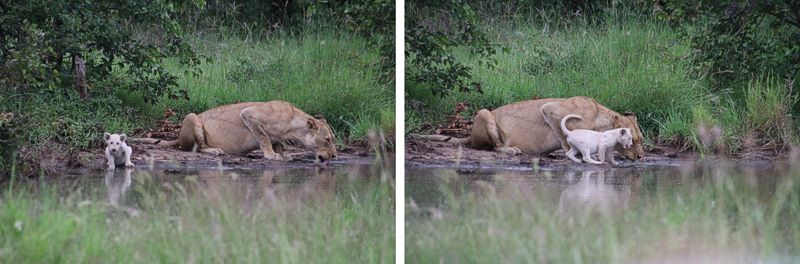
Much to everyone’s surprise, on Wednesday the 26th of February a guide from Motswari Private Game Reserve was spending time with the lionesses and cubs and discovered a little female white lion cub with the two tawny cubs and lionesses! This is incredibly exciting news, as there are only a handful of wild white lions in the world, and we are so happy to hear that we have such a special new addition to this area. The little female cub has been named “Vuxeni” (pronounced “Vu-sheni”), which means “sunrise”.
White lions are not albino lions, but rather lions that carry both recessive genes for white coat colour, which is extremely rare. In the basics of genetics, coat colour is determined by two genes in the DNA - one from the mother and one from the father (much like hair colour or eye colour in humans). As such, each lion carries two genes for coat colour, one inherited from each parent, and either of which can be passed on to the next generation when breeding. The dominant (stronger) gene for coat colour in lions is the natural tawny colour, while the recessive (weaker) gene is the white coat colour. The dominant gene is the one that is outwardly expressed and supresses the recessive gene, so it is possible for any tawny lion to be a carrier of the recessive white gene without us knowing it, as the dominant gene “hides” the recessive gene and the lion appears as tawny even though it is a carrier.
In a white lion, the recessive gene must dominate for coat colour, and the only possible way this can happen is if the recessive gene is inherited from both parents and there is no dominant gene for coat colour inherited to supress it. In that sense, we can tell whether a lion is a carrier of the recessive gene is if it has a white cub, as this means both the mother and father had to pass the recessive gene onto the cub for the cub to be a white lion. This is more accurate for lionesses, as it can be very difficult to determine who the father is.
As such, we cannot confirm who her father is, but based on the territory they are in it is most likely Xakubasa or the tawny male in that coalition of two, considering they are the known dominant males of that territory and were witnessed mating. We are thrilled about the news of the new white lion cub and can only hope she has a long and happy life in the UPNR and will hopefully someday wander onto Ingwelala for us to meet and enjoy!
Vuxeni is now part of the known/confirmed six wild white lions in the world!
Words by Tess Woollgar. Images courtesy of Stacey Pretorius