


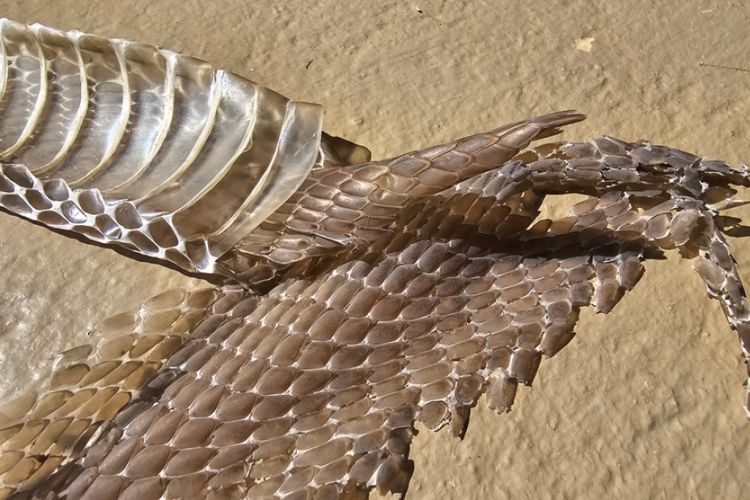
Snake skins have long been a fascination for most nature lovers - an interesting reminder of the beautiful snake that must have been there at some point in time.
The most common questions we get from Members when a snakeskin is found are firstly, what species of snake could it be from, and secondly, how fresh is the skin - or how long ago was the snake there.
It is possible from looking at a snakeskin to determine the species and even a potential timeline of events - but this can be extremely tricky depending on the condition of the skin, where it is, and what elements it may have been subjected to.
For example, an intact skin with no signs of decay or disturbance can indicate a few things: 1. The skin is likely fresh; 2. The size and shape of the snake; 3. The potential behaviour of the snake; and 4. A potential species identification may be possible. However, if a skin is in an area where it is easily exposed to other animals or varying environmental conditions, a reliable identification can be a lot more difficult to achieve. Being exposed to animals, intense heat or wind, for example, will age a skin faster than a skin safely tucked away inside the roof, where exposure to such elements is limited.
This month a wonderful opportunity presented itself for a close-up comparison of two snake skins, both left by Black Mambas, that we simply could not pass up. When called out to look for the mamba, we discovered two skins, side by side, in the wire mesh netting underneath the eave of the outside area of a thatched roof. One skin was old, decaying and in pieces, and the other was completely intact and fresh - a sign that perhaps the mamba had been visiting periodically, over an extended period, to shed its skin in the same area it had before.
When directly compared, the differences are stark - and fascinating! Look at the images below with the two skins side-by-side:
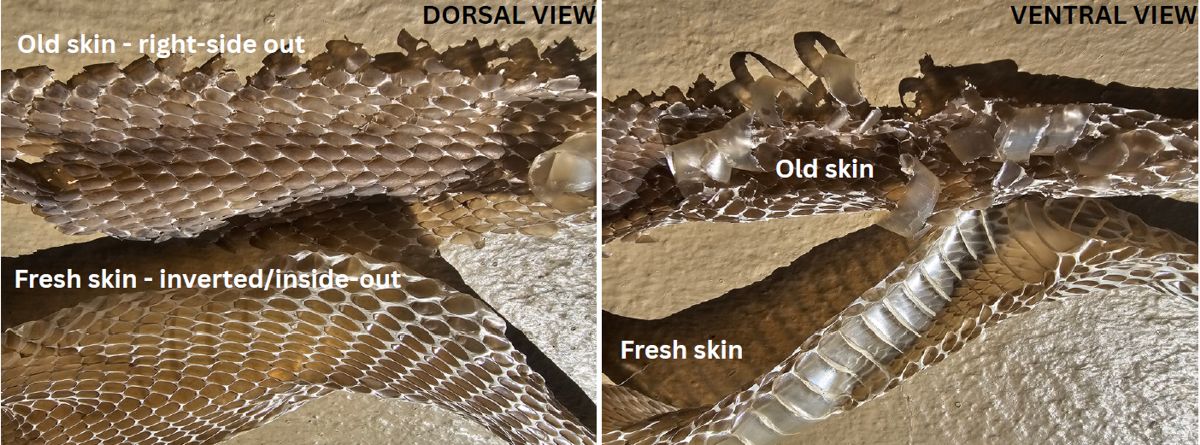
In the above images, the most notable differences between the old skin and the fresh skin are that the old skin has frayed at the edges and has lost some of its definition and shape. Although the scale pattern is still clearly visible, the old skin looks and feels more fragile and has even lost some of its shine. These changes occur as the skin naturally decays over time, coming loose at the scale joints and becoming thinner. The fresh skin, though, is still completely intact at the scale joints, forming a perfect, shiny, hollow tube - and has maintained clear definition throughout. This indicates the shed skin is extremely fresh.
In an instance like this, where a direct comparison is possible, it becomes much easier to see these differences. However, in most cases, only a small portion of a shed skin is found, making it much more difficult to picture the size, head shape, or sometimes even the freshness of the skin. Also remember that smaller snake skins tend to remain intact, while larger ones don’t!
When snakes become too large for their skins, they need to shed the old skin, revealing a new skin underneath - a process known as ecdysis. This is crucial, as the skin cannot stretch beyond a certain size to accommodate a growing snake, and as such must be removed to make space for the snake to continue growing.
Depending on the growth rate of each snake, along with climatic conditions such as humidity, snakes can shed their skins multiple times per year (some up to once a month!). A snake may also shed the skin if large wounds or injuries have healed. To shed the skin, snakes will increase their blood pressure to assist with stretching the skin (sometimes by as much as 40%!) to writhe out of it using any rough surface. This is why we normally find skins on fencing, in the mesh of roofing, or anywhere with some added friction, where the old skin can be pulled off by external surfaces. Shedding can take up to two weeks but usually lasts only a few days.
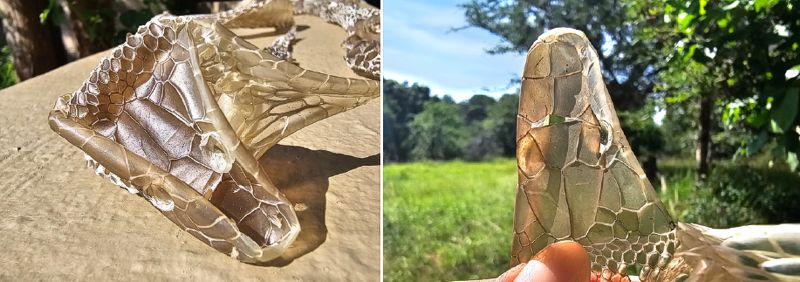
Shedding usually results in an inverted, intact skin being shed - from head to tail, as the snake slides out of the skin bit by bit. This means a fresh skin should still have the eye caps, and indicate all scale joints clearly, albeit inside out from the snake pulling the skin with it as it sheds. But with snakeskins already being paper thin, and prone to breaking easily, it can be extremely difficult to find an intact skin if it is not fresh - so sometimes all we have to work with is a small piece of the skin, acting as a “snapshot” of one area of the snake’s body only. This is particularly relevant with larger snakes, as smaller snake skins are less prone to the elements than larger ones based purely on increased available surface area for disturbance.
Although we may get an “exaggerated” indication of the girth or size of a snake, because the skin stretches during shedding, or the scale patterns on the body from a small piece of skin, this can generally only tell us what type of snake it may be and a rough estimate of size, and is not always a reliable species identification.
The things we look for when identifying a snake from a snakeskin are:
- Scale count (each species has a unique overall scale count)
- Distribution (which species occur in the area, to narrow down the possibilities)
- Overall size (although not accurate, may assist with ruling out certain local species)
- Scale type (e.g. keeled, smooth, granular or overlapping scales). With this, you are looking for whether the scales look rough, are overlapping, are smooth, regular or irregular, etc. to determine what type of snake it may be. As an example, a Black Mamba or a python has smooth scales (shiny), while a Puffadder has larger, rough scales (keeled and dull).
- Scale joints (the orientation and size of the various specific scale joints, particularly on the head scalation of snakes).
- Where the skin is found (although this is more unreliable, it can assist with narrowing down potential species. For example, a Boomslang or Black Mamba will likely shed high up in trees or in roofing, as they are largely arboreal by habit, whereas a Puffadder may shed on the ground in dense thickets, as they are not likely to be found off the ground).
Various resources and field guides are available to assist with snakeskin identification, should you be interested. Please feel free to reach out for details at
Words by Tess Woollgar. Images courtesy of Tess Woollgar.