


September sightings, wildlife monitoring and interesting research projects.`
Sightings of the month
Thank you to all who recorded their sightings in the book this month!
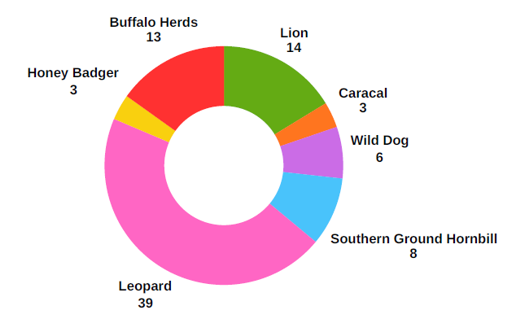
There were 154 recorded sightings in the sightings book during September. Here is the number of recorded sightings of a few highlight species during the month:
Highlights:
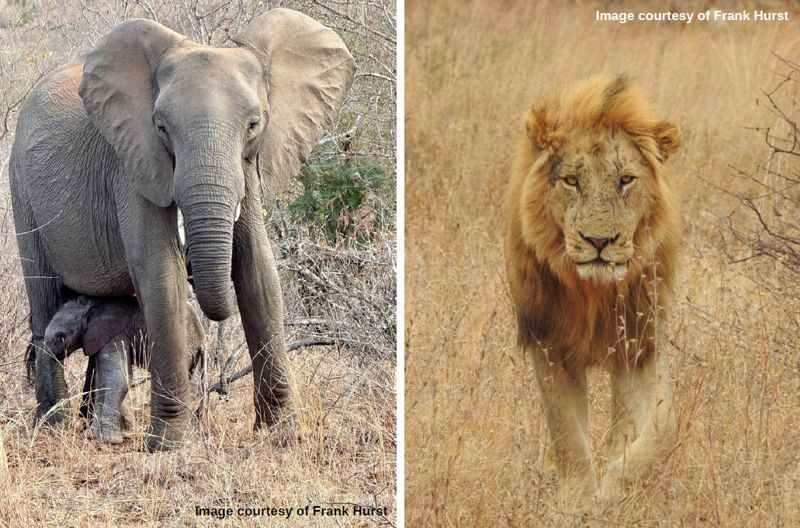
- Leopard sightings were the most frequently recorded, with Elephant and Lion sightings being the next most common. Multiple Leopard kills were recorded during the month, with one kill on Giraffe Road in camp, and another within Sibon Camp.
- Wild Dog sightings have been less frequent than in previous months, however a Wild Dog kill was seen at Buffels Hide and a pack of Wild Dog with puppies was seen near Beacon Boma. It is currently denning season which may explain the less frequent sightings, as the packs move less than usual and in smaller or more localised areas.
- Highlight mammalian sightings: A Caracal was seen with a kitten near Beacon Tower, and a Spotted Hyena was seen carrying a tiny cub in her mouth, likely moving to the active den on the northern side of Argyle Road between the Sibon entrance and the causeway.
- Multiple large Buffalo herds were seen, including a herd of 600+ individuals seen multiple times. Giraffe, Zebra and Kudu sightings remain high, with large herds being seen.
- Mammalian species recorded during September: Leopard, Lion, Elephant, Buffalo, Wild Dog, Spotted Hyena, Side-striped Jackal, Honey Badger, African Wild Cat, Caracal, Large Spotted Genet, Small Spotted Genet, White-tailed Mongoose, Impala, Kudu, Wildebeest, Giraffe, Zebra, Waterbuck, Warthog, Hippo, Nyala, Bushbuck, Klipspringer, Sharpe’s Grysbok, Duiker, Steenbok, Warthog, Chacma Baboon, Vervet Monkey, Scrub Hare, Tree Squirrel, Springhare, Dwarf Mongoose, Banded Mongoose, and Slender Mongoose.

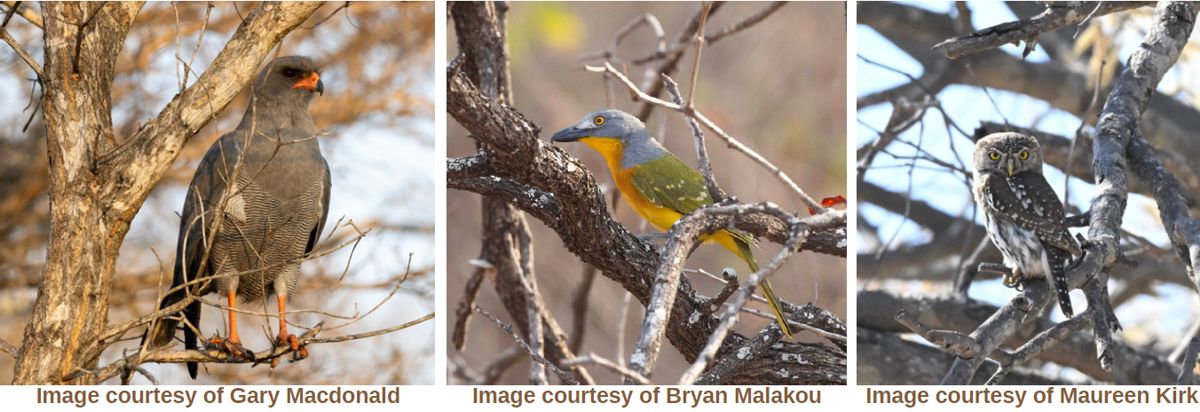
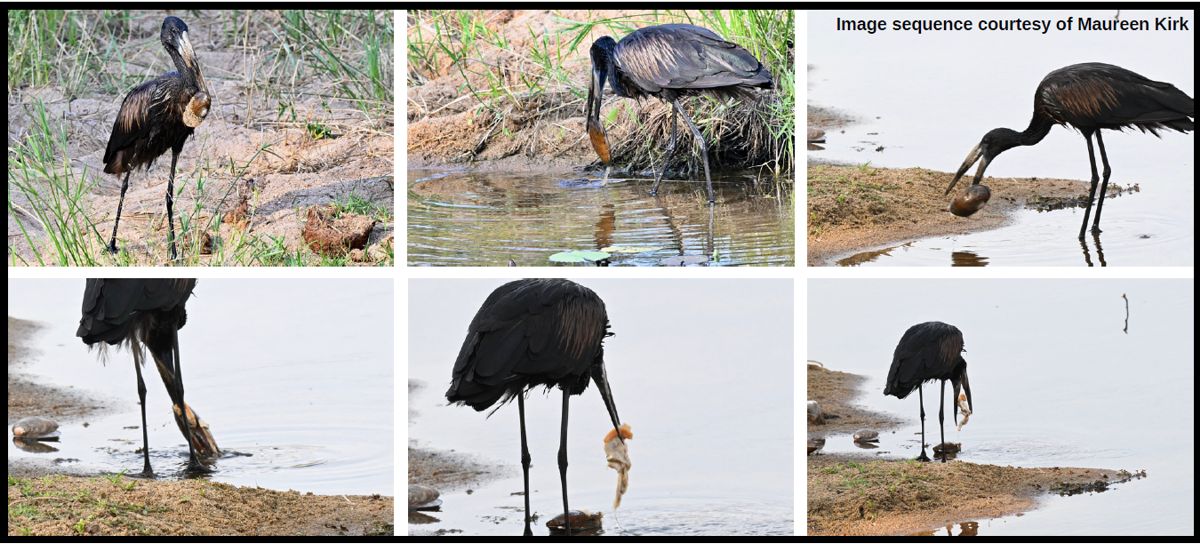
- Birding highlights from September included a newly fledged African Hawk-eagle perched above the nest, an African Jacana seen at Motswari Corner, and a Great Egret also at Motswari Corner. Southern Ground Hornbill sightings were regular as we approach the upcoming breeding season. A new artificial nest was installed for Southern Ground Hornbills on Buffelsbed, near Mermaid Crossing. A Marabou Stork was seen fishing at Main Road Dam. An African Openbill was seen opening and eating freshwater mussels! It used the sharp lower bill to pry them open, forcing the mussel shells apart (see sequence below).
- Reptilian species recorded: Water Monitor, Nile Crocodile, Flap-necked Chameleon, Leopard Tortoise, Marsh Terrapin, Southern African Python, Rainbow Skink and Serrated Hinged Terrapin.
- Bird species recorded: Arrow-marked Babbler, Black-collared Barbet, Crested Barbet, Bateleur, Chinspot Batis, Little Bee-eater, Grey Go-Away Bird, Dark-capped Bulbul, Cinnamon-breasted Bunting, Golden-breasted Bunting, Grey-headed Bush-shrike, Orange-breasted Bush-shrike, Kori Bustard, Rattling Cisticola, Burchell’s Coucal, Long-billed Crombec, Emerald-spotted Wood Dove, Laughing Dove, Ring-necked Dove, Fork-tailed Drongo, African Fish Eagle, Brown Snake Eagle, Martial Eagle, Tawny Eagle, Spotted Eagle-Owl, Verreaux’s Eagle-Owl, Great Egret, Little Egret, African Firefinch, Jameson’s Firefinch, Crested Francolin, Egyptian Goose, Dark Chanting Goshawk, Helmeted Guineafowl, Hamerkop, African Harrier-Hawk, African Hawk-eagle, Retz’s Helmet-shrike, White-crested Helmet-shrike, Green-backed Heron, Grey Heron, African Grey Hornbill, Southern Ground Hornbill, Southern Red-billed Hornbill, Southern Yellow-billed Hornbill , Brown-hooded Kingfisher, Giant Kingfisher, Pied Kingfisher, Yellow-billed Kite, Red-crested Korhaan, African Jacana, Blacksmith Lapwing, Crowned Lapwing, Sabota Lark, Red-faced Mousebird, African Openbill, Black-headed Oriole, African Scops Owl, African Barred Owlet, Pearl-spotted Owlet, Red-billed Oxpecker, Yellow-billed Oxpecker, Brown-headed Parrot, Three-banded Plover, Tawny-flanked Prinia, Black-backed Puffback, White-browed Robin-Chat, White-throated Robin-Chat, Lilac-breasted Roller, Purple Roller, Double-banded Sandgrouse, Common Scimitarbill, White-browed Scrub-robin, Magpie Shrike, Southern White-crowned Shrike, Southern Grey-headed Sparrow, Cape Sparrow, Natal Spurfowl, Swainson’s Spurfowl, Burchell’s Starling, Cape Starling, Greater Blue-eared Starling, Black Stork, Marabou Stork, Saddle-billed Stork, Woolly-necked Stork, Yellow-billed Stork, Amethyst Sunbird, White-bellied Sunbird, Lesser Striped Swallow, Black-crowned Tchagra, Brown-crowned Tchagra, Water Thick-knee, Kurrichane Thrush, Southern Black Tit, White-backed Vulture, White-headed Vulture, Blue Waxbill, Lesser Masked Weaver, Red-headed Weaver, Red-billed Buffalo Weaver, Long-tailed Paradise Whydah, Green Wood-hoopoe, Golden-tailed Woodpecker and Stierling’s Wren-Warbler.
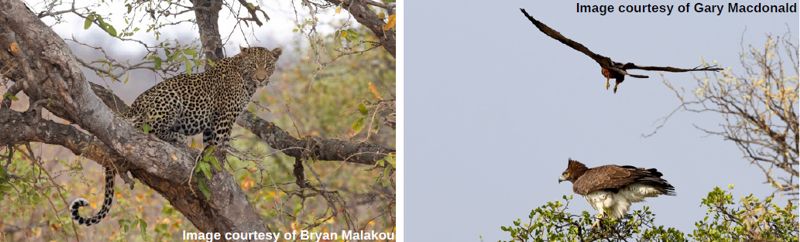
Historical Sightings 2005
As part of our project to digitise all available historical sightings records for Ingwelala, we have the privilege of being able to compare sightings, compositions and data from then to now. This month, we digitised the historical sightings recorded in the sightings book from 2005. Below are some interesting comparisons between 2005 and 2025:
- Lion pride sightings in 2005 averaged 12+ lions per pride. In 2025, the average is 4 lions per sighting or pride.
- Recorded inter-species interactions were incredibly diverse in 2005:
- A Wahlberg’s Eagle fighting with an owl
- An interaction between a Martial Eagle, an African Wild Cat and a mongoose, during which the Wild Cat was stalking the mongoose, but was forced into hiding by the eagle when it became the intended prey instead of the predator. All left untouched, it seems.
- A Fish Eagle had a battle with a large barbel/catfish.
- A pride of Lions killed a Buffalo in Thorpe’s Dam, which took over 6 hours.
- An African Wild Cat was seen killing a rodent, a Honey Badger was seen killing a Nightjar and a Southern African Python was seen killing an Impala lamb.
- A Lapwing defending a nest from a Slender Mongoose. - In total, there were 37 recorded kills during 2005. Thus far, we have 57 recorded kills for 2025. That is an average of 3 kills recorded per month in 2005 and 6 kills per month in 2025.
- There were 106 different species recorded in the sightings book in 2005, and 141 recorded thus far in 2025. Of those, birds made up 51% of all recorded sightings in both years.
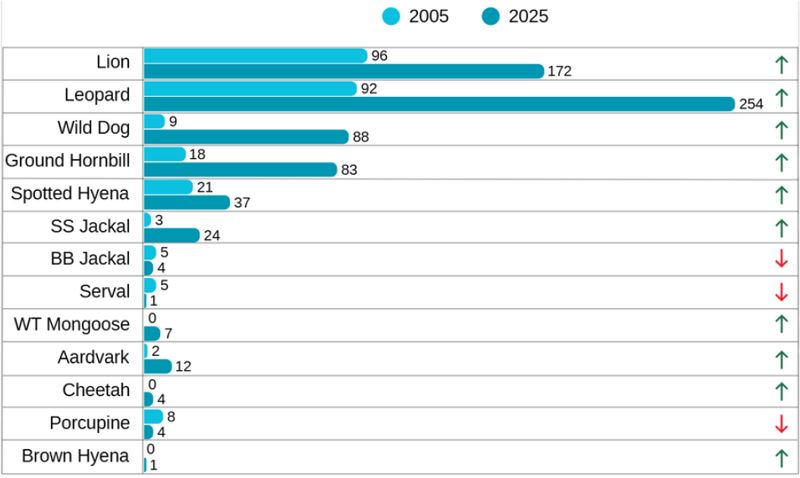
Below is a weighted comparison of the number of sightings for different species for 2005 and 2025. On the right-hand side is also an overall indicator of increased or decreased sightings per species.
Highlight or unusual sightings in 2005 included:
- A Caracal with three kittens seen twice, a Leopard seen with two cubs, and two Genets seen with three kittens.
- A blind Elephant cow was seen on multiple occasions, often alone or with bulls.
- Mating animals were observed often, which included Elephants, Buffaloes and Leopards.
- There were three sightings of a Southern African Python of over 4m long.
- A single Aardvark sighting was recorded for the year, at Timbavati Crossing.
- An Ashy Tit was recorded, which is further east than the usual distribution of this species.
- The vast majority of recorded Elephant, Wildebeest and Nyala sightings were of single bulls as opposed to herds or even small groups.
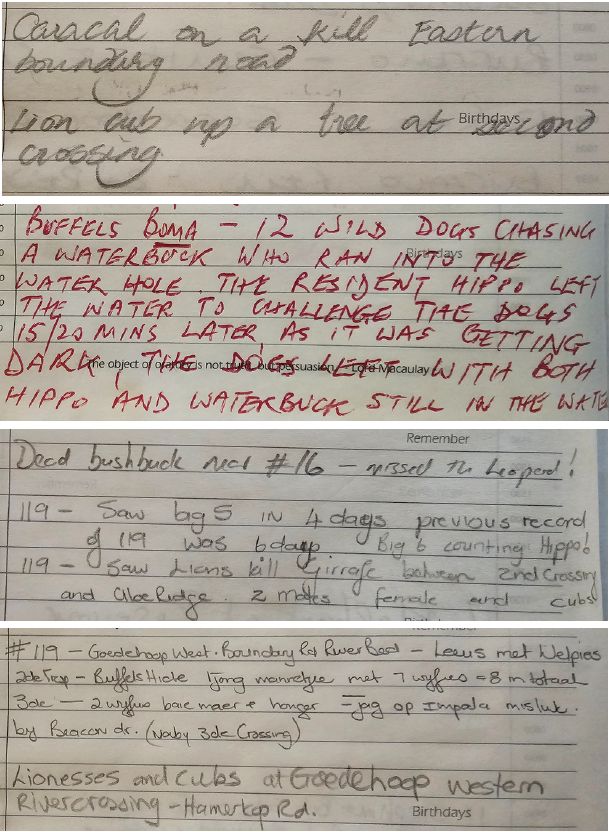
We are immensely grateful to all who have recorded sightings in the book, both historically and now. We appreciate it! Included are some images of sightings taken directly from the book.
To note:
When analysing data such as this, although we can compare total numbers across the years, which is still a good general indication of the overall changes, it would be more accurate to compare the data using occupancy rates at varying times of the year, the total number of people per month, the historical rainfall and weather conditions, or any other notable environmental influences in those time frames being compared.
It is also important to note that this data only represents what was written into the book and assumes that those sightings were recorded accurately. However, we must account for human error and for information that may not have been recorded at the time, then or now.
There are many other factors that could come into play, but those would be impossible to determine (e.g. the frequency, durations and times that people went on drives, etc.), but if even the above occupancies and such are accounted for accurately, or as accurately as possible, it would be possible to use this data to assist with broader conservation or management monitoring and research.
Words by Tess Woollgar, images courtesy Maureen Kirk and as notated on individual photos.