


May sightings, wildlife monitoring and interesting research projects.`
Sightings of the month
Thank you to all who recorded their sightings in the book this month!
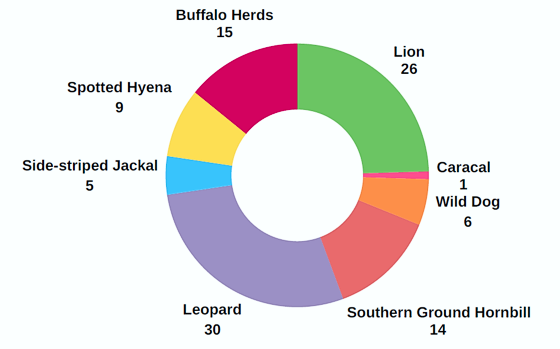
There were 184 recorded sightings in the sightings book during May. Here is the number of recorded sightings of a few highlight species during the month:
Highlights:
- Leopard sightings once again outnumbered other species by a large margin, with 30 recorded sightings. Lion sightings totalled 26, of which several were at kills. Wild Dogs were less frequently seen, with only six recorded sightings for the month.
- Highlight mammalian sightings: A Caracal was seen on the tar road, while a Porcupine was spotted at our airfield! There were two African Wild Cat sightings, one of which was seen with a Scrub Hare kill, and a Civet was seen in camp.
- Birding highlights included a sighting of a Cape Starling feeding a young Great Spotted Cuckoo, fourteen sightings of Southern Ground Hornbills, five species of Vultures observed together, and three species of Indigobird observed over two days.
- Reptilian species recorded: Rock Monitor, Water Monitor, Nile Crocodile, Flap-necked Chameleon, Leopard Tortoise, Giant Plated Lizard, Marsh Terrapin, Mozambique Spitting Cobra, Black Mamba, Schlegel’s Blind Snake, Southern African Python, Red-lipped Herald and Serrated Hinged Terrapin.
- Mammalians recorded during May: Leopard, Lion, Wild Dog, Spotted Hyena, Side-striped Jackal, African Wild Cat, African Civet, Caracal, Porcupine, Bushbaby/Galago, Elephant, Buffalo, Rhino, Impala, Kudu, Wildebeest, Giraffe, Zebra, Waterbuck, Warthog, Hippo, Nyala, Bushbuck, Klipspringer, Sharpe’s Grysbok, Duiker, Steenbok, Warthog, Chacma Baboon, Vervet Monkey, Scrub Hare, Tree Squirrel, Springhare, Dwarf Mongoose, Banded Mongoose, and Slender Mongoose.
- Bird species recorded: Arrow-marked Babbler, Crested Barbet, Bateleur, Chinspot Batis, Little Bee-eater, Grey Go-Away Bird, Dark-capped Bulbul, Cinnamon-breasted Bunting, Golden-breasted Bunting, Grey-headed Bush-shrike, Kori Bustard, Burchell’s Coucal, Bronze-winged Courser, Black Crake, Jacobin Cuckoo, Great Spotted Cuckoo, Levaillant’s Cuckoo, Emerald-spotted Wood Dove, Laughing Dove, Namaqua Dove, Ring-necked Dove, Fork-tailed Drongo, African Fish Eagle, Brown Snake Eagle, Martial Eagle, Tawny Eagle, Wahlberg’s Eagle, Verreaux’s Eagle-Owl, African Firefinch, Jameson’s Firefinch, Grey-Tit Flycatcher, Crested Francolin, Egyptian Goose, Gabar Goshawk, Helmeted Guineafowl, Hamerkop, African Harrier-Hawk, African Hawk-eagle, Retz’s Helmet-shrike, White-crested Helmet-shrike, Green-backed Heron, Grey Heron, Goliath Heron, Greater Honeyguide, African Grey Hornbill, Southern Ground Hornbill, Southern Red-billed Hornbill, Southern Yellow-billed Hornbill, Dusky Indigobird, Purple Indigobird, Village Indigobird, African Pygmy Kingfisgher, Brown-hooded Kingfisher, Giant Kingfisher, Half-collared Kingfisher, Pied Kingfisher, Red-crested Korhaan, Blacksmith Lapwing, Crowned Lapwing, Sabota Lark, Red-faced Mousebird, Black-headed Oriole, African Scops Owl, Pearl-spotted Owlet, Red-billed Oxpecker, Yellow-billed Oxpecker, Brown-headed Parrot, Three-banded Plover, Tawny-flanked Prinia, Black-backed Puffback, Green-winged Pytillia, Lilac-breasted Roller, Purple Roller, Double-banded Sandgrouse, White-browed Scrub-robin, Shikra, Magpie Shrike, Red-backed Shrike, Southern White-crowned Shrike, Southern Grey-headed Sparrow, Natal Spurfowl, Swainson’s Spurfowl, Burchell’s Starling, Cape Starling, Greater Blue-eared Starling, Black Stork, Saddle-billed Stork, White Stork, Woolly-necked Stork, Yellow-billed Stork, White-bellied Sunbird, Barn Swallow, Little Swift, Black-crowned Tchagra, Brown-crowned Tchagra, Water Thick-knee, Groundscraper Thrush, Kurrichane Thrush, Southern Black Tit, Cape Vulture, Hooded Vulture, Lappet-faced Vulture, White-backed Vulture, White-headed Vulture, Blue Waxbill, Cape Weaver, Lesser Masked Weaver, Red-headed Weaver, Spectacled Weaver, Red-billed Buffalo Weaver, Long-tailed Paradise Whydah, Green Wood-hoopoe, Golden-tailed Woodpecker and Stierling’s Wren-Warbler.

- Invertebrate sightings have reduced, with mostly scorpions and spiders still being seen. Plenty of Baboon spiders were observed. In general, less butterflies, flies, mosquitoes and other small invertebrates wereobserved during the month.
- As we move into the winter months, please remain vigilant for snakes and scorpions. With temperatures being cooler, these animals may seek warmth inside or around bungalows and vehicles, and will try to find areas that provide shelter - especially in cupboards, under furniture, or anywhere that may be used to store items that are not regularly disturbed.
Words by Tess Woollgar, images courtesy of Gary Macdonald, George Fleet, Josh Hibbett, Willichia Venter and Tessa Woollgar