


February sightings, wildlife monitoring and interesting research projects.`
Sightings of the month!
Thank you to all who recorded their sightings in the book this month!
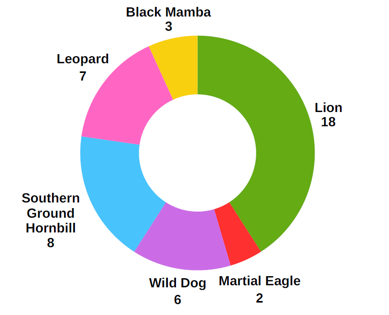
There were 105 recorded sightings in the sightings book, with extremely thick veld conditions making sightings challenging. Here is the number of recorded sightings of a few species during the month:
Highlights:
- Elephant sightings were the most reported species in the sightings book. Following this, lions, Southern Ground Hornbills, leopards and buffaloes were the next most frequent.
- Lion sightings provided a great deal of diversity this month, with sightings of a mating pair, lionesses with cubs, male lions and coalitions, and everything in between. Lion movements were also vast and unusually high this month, with sightings of the above lions spread across Argyle, Buffelsbed and Op Goedehoop!
- An African Wild Cat was seen near the Hammerkop causeway on the tar road, marking our only small cat sighting for the month.
- A newborn giraffe calf was seen on numerous occasions on Buffelsbed, with the umbilical cord still attached. Within the journey, there were at least another two cows that were heavily pregnant, so more calves are expected in the family soon!
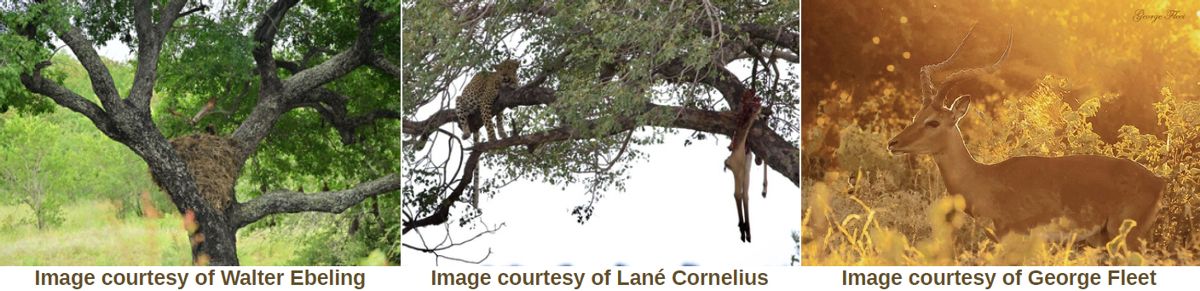
- The Southern Ground Hornbill family nested in a hollowed Apple Leaf tree in camp, north of the swimming pool, but unfortunately their chick did not survive the rains. They have, however, been active near the artificial nesting site at Mermaid Crossing since then!
- Reptile sightings were frequent, with black mambas being the most recorded species. One sighting included multiple squirrels chasing a black mamba up a tree in camp! Further, a Common File Snake was seen at bungalow #16, which is a highly unusual sighting. This species is largely nocturnal and usually spend most of their time underground. This is the first recorded sighting of a Common File Snake that we could find for Ingwelala!
- Birding highlights included multiple sightings of Martial Eagles, a Dwarf Bittern, various cuckoo species and Buffy Pipits.
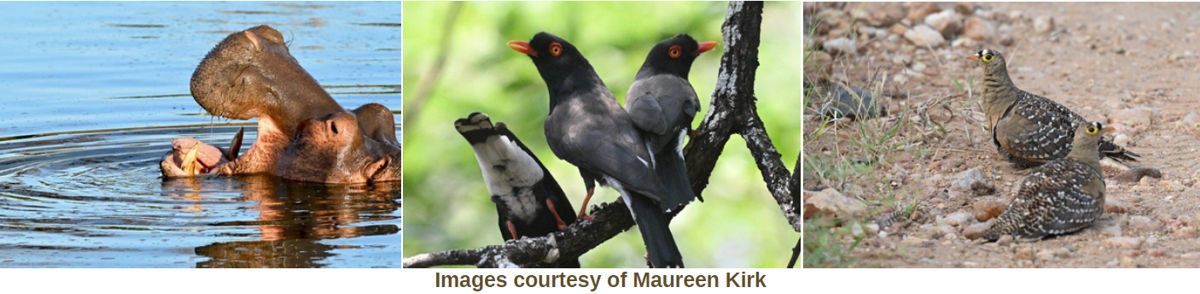
- Mammalian species recorded: Leopard, Lion, Elephant, Buffalo, Wild Dog, Spotted Hyena, African Wild Cat, Impala, Kudu, Wildebeest, Giraffe, Zebra, Waterbuck, Warthog, Hippo, Nyala, Bushbuck, Klipspringer, Sharpe’s Grysbok, Duiker, Steenbok, Warthog, Chacma Baboon, Vervet Monkey, Scrub Hare, Tree Squirrel and Dwarf Mongoose.
- Reptilian species recorded: Water Monitor, Black Mamba, Mozambique Spitting Cobra, Common File Snake, Nile Crocodile, Flap-necked Chameleon, Leopard Tortoise, Marsh Terrapin, Rainbow Skink and Serrated Hinged Terrapin.
- For the full list of bird species recorded during the month, please click here.

Southern Ground Hornbills: Breeding season update
For those who were on site in December or January, you may recall that a family of Southern Ground Hornbills, the same family that had previously nested on Argyle near the Tower, were seen regularly flying into camp carrying nesting materials and food. Being peak breeding season at the time and seeing the many flights into the same region of camp, it was most likely that they had chosen a new natural nest and were actively using it.
After intensive searching on foot in the very thick vegetation north of the swimming pool, in early February two potential nesting sites were identified by the conservation team to be inspected as the most likely nesting sites in the area. When inspected by the APNR Ground Hornbill Project the following day, it was discovered that one of those sites, in an old hollowed-out Apple Leaf tree, was indeed their nesting site! Unfortunately, despite the regular sightings of them bringing food into the area, the chick did not survive. The most likely explanation is that the intensive rainfall was funnelled into the natural nest cavity, and the chick could not withstand the elements for such a prolonged period of time.
The shape and position of the natural nest the birds selected was unfortunately not ideal for such unprecedented rains, with a large entrance and plenty of exposure to the elements, and thus not allowing much protection for the chick in such extreme circumstances. It seems that, from the activity at the nest in the days prior to the visit, and from the state of decomposition of the chick, that the family continued to bring food items after the chick had already passed away. This behaviour is not uncommon in Southern Ground Hornbills.
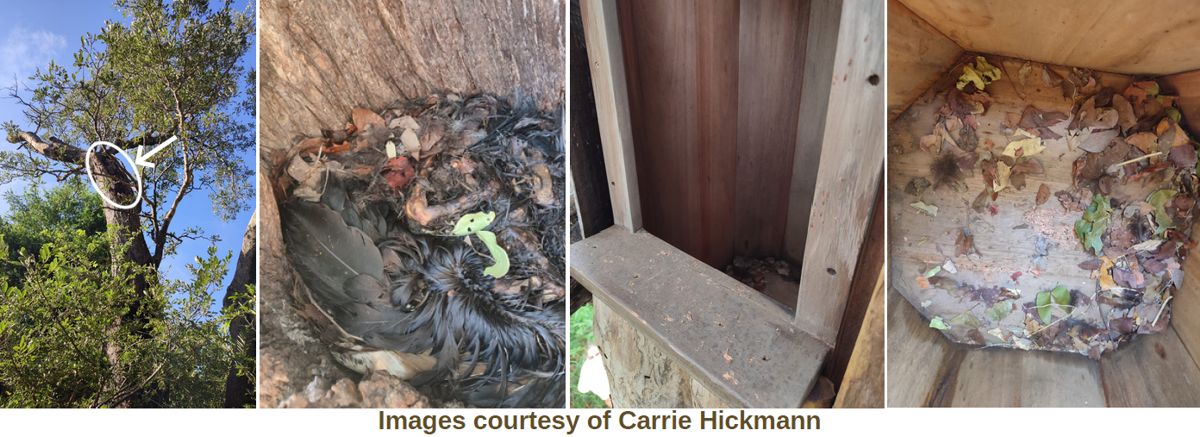
Interestingly, though, and on a positive note - the same family of Southern Ground Hornbills was observed mating in a nearby tree in the same time frame, suggesting that they may be trying again this season! This is quite unusual, as February is considered very late in the traditional breeding season for Southern Ground Hornbills. However, with the extended and extensive rainfall in January, according to the APNR Ground Hornbill Project’s research, this breeding season has shown an enormous amount of variety in terms of timelines, with some chicks having fledged already while other birds are still laying eggs.
As such, there is hope yet! And even more so considering that when the artificial nest on Buffelsbed, known as “Mermaid Nambu Nest”, was checked after reports of sightings of that family near Mermaid Crossing, and it seems that nest has had activity too! Fresh feathers and nest linings were observed, as well as marks where the birds have been “testing” the nest with their beaks. Positively, on the project’s second visit for the month, there had been more activity at the artificial nest again! A camera trap has now been set up at the artificial nest to monitor activity. Perhaps, if the birds are lucky, they may still be successful this breeding season.
Fish survey in the UPNR
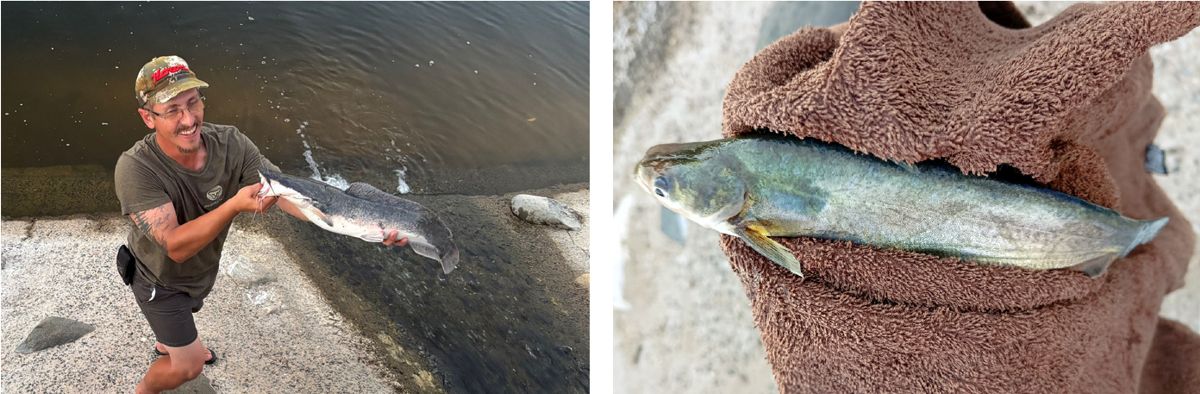
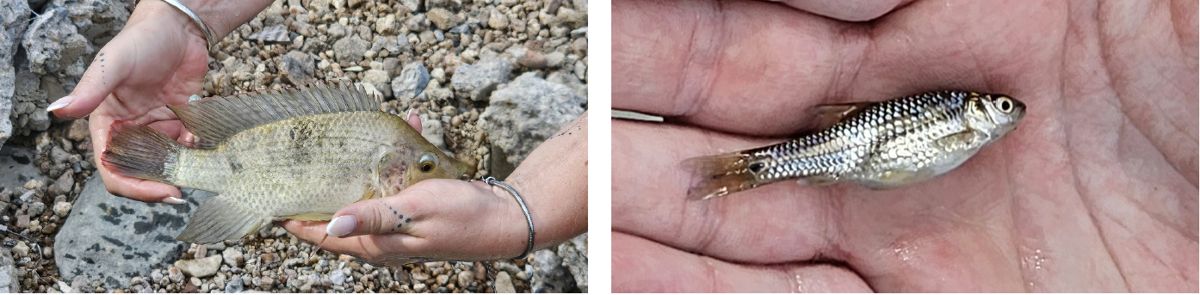
The strongly flowing rivers and enormous number of fish have provided an interesting and much-needed research opportunity in the UPNR: a fish survey of our freshwater species. Thanks to the efforts of the warden, all properties were presented with the opportunity to apply for limited catch-and-release permits to contribute to an ongoing fish survey for the UPNR.
With permits in hand, our team has been hard at work after hours adding valuable data to the survey, with multiple species caught, photographed and safely released. We would like to thank all who are involved in this ongoing study. Data of this kind is difficult to come by, and we will continue to contribute as much as we can until the water supplies run out.
As a reminder, these permits are on a catch-and-release basis only, and fishing is only allowed by current valid permit holders partaking in the fish survey in the region.
Below are some highlights, with some of the species identified thus far include African Tiger Fish, Threespot Barb, Mozambique Tilapia, Red-breasted Tilapia, Large-scaled Yellowfish and various Catfish species.

Words by Tess Woollgar, images courtesy of Stuart du Toit, Josh Hibbet, Tess Woollgar, Ingrid Passier, and as noted on individual photos.