


April sightings, wildlife monitoring and interesting research projects.`
Sightings of the month
Thank you to all who recorded their sightings in the book this month!
With 243 recorded sightings in the book, there was an average of eight sightings per day. Within this total, Leopards were the most recorded species, more than twice as frequently as Lions. Wild Dogs were seen multiple times, with three different packs recorded in the area over the month.

Highlights:
- Recorded kills were at an extreme high, totalling fifteen kills. There were five Leopard kills, three Wild Dog kills and two Lion kills recorded. Rarer kills included a Southern Ground Hornbill killing a Scrub Hare, Wild Dogs killing a mongoose and a Fish Eagle that was seen eating a terrapin.
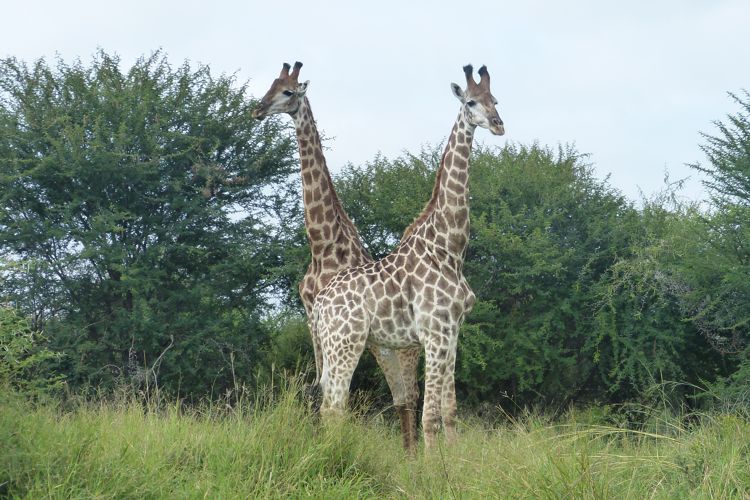
- Mammalian highlights: There were two Cheetah sightings at the beginning of the month, and a Porcupine sighting as well. Mating Elephants were seen at Motswari Corner and mating Lions were seen twice on Argyle. An Aardwolf was reportedly seen on Umbabat Road, but we have no further details or images of this sighting. A Lioness with fresh suckle marks was seen at Farmhouse Crossing, indicating there may be a den close by.
- Mammalians recorded: Leopard, Lion, Wild Dog, Cheetah, Spotted Hyena, Honey Badger, Black-backed Jackal, Side-striped Jackal, African Wild Cat, Aardwolf, Porcupine, Bushbaby/Galago, White-tailed Mongoose, Elephant, Buffalo, Rhino, Impala, Kudu, Blue Wildebeest, Giraffe, Zebra, Waterbuck, Warthog, Hippo, Nyala, Bushbuck, Klipspringer, Sharpe’s Grysbok, Duiker, Steenbok, Warthog, Chacma Baboon, Vervet Monkey, Scrub Hare, Tree Squirrel, Springhare, Dwarf Mongoose, Banded Mongoose, and Slender Mongoose.

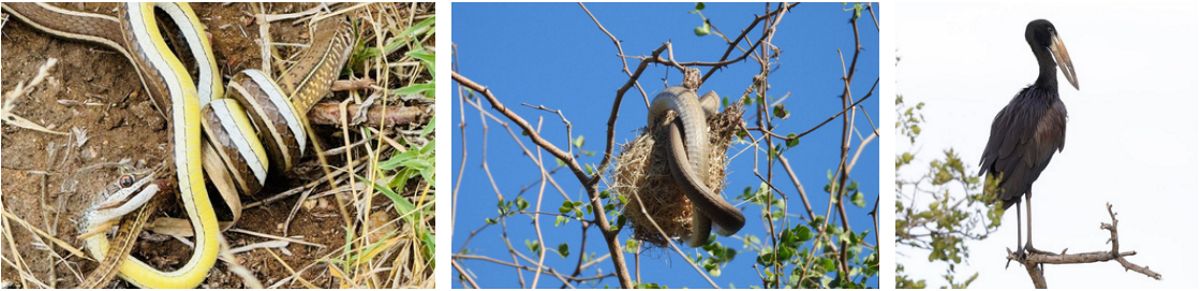
- Reptilian highlights: a Yellow-bellied Sand Snake eating a Yellow-throated Plated Lizard (Image 1), a Boomslang raiding Weaver nests at Sibon (Image 2), a crocodile eating a snake, and a Peter’s Thread Snake that was spotted in camp. There were also multiple Puffadder and Black Mamba sightings this month.
- Reptilian species recorded: Rock Monitor, Water Monitor, Nile Crocodile, Flap-necked Chameleon, Leopard Tortoise, Giant Plated Lizard, Yellow-throated Plated Lizard, Yellow-bellied Sand Snake, Marsh Terrapin, Mozambique Spitting Cobra, Black Mamba, Spotted Bush Snake, Puffadder, Peter’s Thread Snake, Boomslang, Stiletto Snake, Spotted Skaapsteker and Serrated Hinged Terrapin.
- Birding highlights included two sightings of an African Openbill at the main causeway, a Booted Eagle, two sightings of African Crakes at Zebra pan (Image 3), eleven Kori Bustard sightings, a family of Dusky Indigobirds and a Kurrichane Buttonquail.
Reptilian species recorded: Rock Monitor, Water Monitor, Nile Crocodile, Flap-necked Chameleon, Leopard Tortoise, Giant Plated Lizard, Yellow-throated Plated Lizard, Yellow-bellied Sand Snake, Marsh Terrapin, Mozambique Spitting Cobra, Black Mamba, Spotted Bush Snake, Puffadder, Peter’s Thread Snake, Boomslang, Stiletto Snake, Spotted Skaapsteker and Serrated Hinged Terrapin. - Bird species recorded: Arrow-marked Babbler, Crested Barbet, Bateleur, Chinspot Batis, European Bee-eater, Little Bee-eater, Southern Carmine Bee-eater, Grey Go-Away Bird, Dark-capped Bulbul, Cinnamon-breasted Bunting, Golden-breasted Bunting, Grey-headed Bush-shrike, Kori Bustard, Kurrichane Buttonquail, Bronze-winged Courser, African Crake, Black Crake, Jacobin Cuckoo, Great Spotted Cuckoo, Levaillant’s Cuckoo, Emerald-spotted Wood Dove, Laughing Dove, Namaqua Dove, Ring-necked Dove, Fork-tailed Drongo, Spotted Flycatcher, African Fish Eagle, Black-chested Snake Eagle, Booted Eagle, Brown Snake Eagle, Martial Eagle, Tawny Eagle, Verreaux’s Eagle-Owl, African Firefinch, Jameson’s Firefinch, Crested Francolin, Egyptian Goose, Helmeted Guineafowl, African Harrier-Hawk, African Hawk-eagle, Retz’s Helmet-shrike, White-crested Helmet-shrike, Green-backed Heron, Grey Heron, Goliath Heron, African Grey Hornbill, Southern Ground Hornbill, Southern Red-billed Hornbill, Southern Yellow-billed Hornbill, Dusky Indigobird, Giant Kingfisher, Pied Kingfisher, Woodland Kingfisher, Yellow-billed Kite, Red-crested Korhaan, Blacksmith Lapwing, Crowned Lapwing, African Openbill, Black-headed Oriole, African Scops Owl, Red-billed Oxpecker, Yellow-billed Oxpecker, Brown-headed Parrot, Three-banded Plover, Tawny-flanked Prinia, Black-backed Puffback, European Roller, Lilac-breasted Roller, Purple Roller, Double-banded Sandgrouse, Common Sandpiper, Wood Sandpiper, White-browed Scrub-robin, Magpie Shrike, Red-backed Shrike, Southern White-crowned Shrike, Southern Grey-headed Sparrow, Chesnut-backed Sparrow-lark, Natal Spurfowl, Swainson’s Spurfowl, Burchell’s Starling, Cape Starling, Black Stork, Saddle-billed Stork, Woolly-necked Stork, White-bellied Sunbird, Barn Swallow, Brown-crowned Tchagra, Water Thick-knee, Groundscraper Thrush, Southern Black Tit, Hooded Vulture, White-backed Vulture, White-headed Vulture, Blue Waxbill, Cape Weaver, Lesser Masked Weaver, Red-headed Weaver, Spectacled Weaver, Red-billed Buffalo Weaver, Long-tailed Paradise Whydah, Green Wood-hoopoe, Golden-tailed Woodpecker and Stierling’s Wren-Warbler.
- Invertebrates have started to become less active, although scorpions and spiders are still populous. Highlight invertebrate sightings included:
Beautiful, bright orange butterflies known as the Clear-spotted Acraea (Acraea aglaonice) have been populous this month. This spotted butterfly can be seen on low forbs and grasses out in the field year-round but is known to peak in population size in summer and autumn. With a wingspan of around 5cm, this is one of the larger butterflies found in the area, and certainly one of the brightest. It has similar colouration to the African Monarch Butterfly - an indication that it wants animals to think it is poisonous. This is called aposematic colouration.
Jumping spiders have been plentiful as well. Often found on game viewers, under debris or around the house, these friendly spiders are harmless to humans and tend to be slow moving (until they leap!). They’re free-living (don’t build webs) and are known to be quite intelligent! They eat mosquitoes and flies, playing a vital role in pest control. Most jumping spiders are smaller than a pea, but here we get some much larger species up to the size of a R5 coin - mostly from the genus Hyllus.
Armoured Bush Crickets / Armoured Ground Crickets / Corn Crickets, although quite large, are tricky to spot in the bush. These crickets can reach up to 5cm in length and eat mostly plant material. They’re considered to be mostly terrestrial, being more active during the day than at night. They are not commonly eaten, with the limited predators of this insect including large birds, Jackals, Kori Bustards and Bat-eared Foxes. This cricket was spotted with another on the branch of a Grewia bush near Farmhouse Crossing on Argyle and measured just under 5cm in length.
Baboon Spiders, although not easily seen, have also been a highlight this month. Their hole nests in the ground can be spotted from a distance, and occasionally if you are lucky, you may see one out of the nest. A recent sighting of one crossing the road was a definite highlight, but the one pictured on the right was found in someone’s bed during the night! It was safely relocated. Related to Tarantulas, Baboon Spiders can grow to around 15cm in size and are very hairy! Although they are large and can look intimidating, Baboon spiders are mostly docile and slow-moving. Baboon spiders are predatory and are our longest-lived spider species at Ingwelala, having been known to live up to 25 years old in the wild.

Words by Tess Woollgar, images courtesy of Tyron Ryder, Ian Donkin, Shannon Rogotzki, Willichia Venter, Josh Hibbett and Tessa Woollgar