


January sightings, wildlife monitoring and interesting research projects.`
Sightings of the month
Thank you to all who recorded their sightings in the book this month!
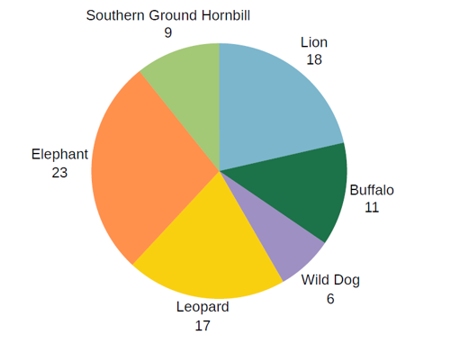
Here is the number of recorded sightings per major species:
Highlights:
- Lion and Leopard sightings once again made up many of the species recorded, at a total of 18 lion sightings and 17 leopard sightings. In numbers, this equated to around 130 lions and 25 leopards. This was 30% of the total recorded sightings across all species.
- Some mammal highlights were the Wild Dogs on 6 occasions, 1 African Wildcat, 1 Sharpe’s Grysbok and 1 Elephant Shrew!
- The Klipspringers in camp have a new addition to their family!
- A small group of Bushbuck, including 2 males and 1 female, have been a regular in camp.
- Recorded Southern Ground Hornbill sightings have gone up substantially, now with 9 recorded sightings of 26 animals in total.
- Birding highlights were: Eurasian Golden Oriole, Great Spotted Cuckoo, Levaillant’s Cuckoo, Retz’s Helmet-shrikes nesting at Bungalow 59, White-backed Vulture and Hooded Vulture.
- Reptile highlights: Rock Monitor, Mozambique Spitting Cobra, Black Mamba hunting hornbills in a nest.
- Other general species recorded through the month: Kudu, Wildebeest, Giraffe, Zebra, Waterbuck, Hippo, Nyala, Crocodile, Spotted Hyena, Duiker, Steenbok, Warthog, Baboon, Vervet Monkey, Scrub Hare, Tree Squirrel, Springhare, Leopard Tortoise.
Recording Sightings
The sightings logbook at reception as well as our Social Media groups are a massive help and an impressive tool when it comes to Conservation. We have seen a huge increase in the accuracy and diversity of the sightings recorded, and we would like to thank everyone for their efforts with this - we appreciate the details so much, and we don’t want this to go unnoticed. Thank you, especially, to those who have shared photos and videos with us and taken the time to record the details so carefully - because of you, we are making huge progress.
We are happy to say that over the last 2 months, thanks to everyone involved, we have managed to record 130 major sightings on Ingwelala. This has also allowed us to track specific animals’ movements, particularly lion prides and leopards, and contribute towards the ID kits of multiple male lions, lion prides and leopards in the area.
Thank you all again for your interest and efforts - it would not be possible without you.
Please keep the details coming in - this will be an ongoing initiative for long-term studies and analyses.

Screenshot of some of the recorded activity on Ingwelala using EarthRanger
In the above screenshot from EarthRanger, you can see some of the sightings grouped together by area, along with invasive plants and various areas selected for Veld Rehabilitation. These are just some of the customisations and sightings logged onto the site within the last 2 months.
Please note that Rhino sightings are never recorded online or on any platform. The icon of the Rhino and Elephant on the map is the general icon EarthRanger uses for Wildlife Sightings.
Desert Cisticola on Ingwelala!
While out on the reserve in the last week of January, we were lucky enough to hear the call of a Desert Cisticola! At Ingwelala we are situated right on the edge of this species’ distribution in southern Africa, but this is not a common bird we see or hear in these parts very often.
Found throughout dry grasslands in the arid and semi-arid regions on southern Africa, it is known to occur more commonly in areas of high rainfall in the north and eastern parts, with a distribution mainly in the Northern Cape, Free State, Botswana, and Namibia. It was quite a special treat to have heard one on Ingwelala in January.
Keep an eye and ear out for this beautiful little bird - maybe you’ll get lucky!
Words by Tess Woollgar, images by Josh Hibbett, Ingrid Passier, Caroline Culbert and EarthRanger.