


January continued where we left off in December with high humidity and ambient temperatures hovering around the 40 degree mark for most of the early part of the month.
Official temperatures recorded were a minimum of 18 degrees and a maximum of 40 degrees Celsius, with an average humidity of 84%.
The first month of the year is always focused on the clean-ups and various tasks including the staff leave cycles that are postponed or rescheduled after the busy festive season. This January refuse removal and general sanitizing was the priority. Four full truckloads of domestic waste were removed from the Reserve.
As expected with the marula fruit ripening the elephants especially took full advantage of this seasonal offering. Both the camp and Sibon fences were breached often by elephants attracted to marula trees.
Tropical cyclone Eloise was the centre feature in the third week of January as she impacted locally in the north eastern sections of the province. A range of actions were initially triggered as people prepared for the possibility of extensive storm damage. Management preparation commenced early, taking into consideration what transpired during the Dando flood in 2012. These precautionary measures included stocking up with diesel for the generator, basic food items in the shop, water pipe fittings, placement of potable water on the west side of the Nhlaralumi and bulk water storage in camp and Sibon.
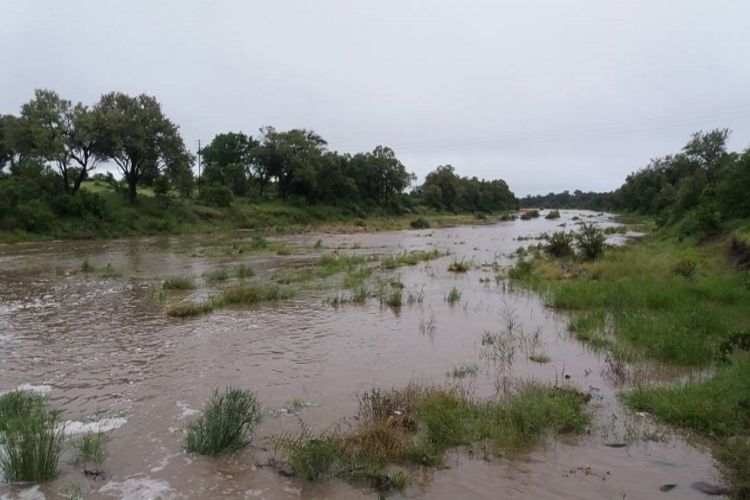
With much appreciation Eloise impacted on Ingwelala in a gentle way. The rain fell over an extended period with manageable run off, the power supply generally held out, as did the main water reticulation. All three river systems flowed strongly. Total rainfall for was 251.6 mm. Veld condition is simply sublime.
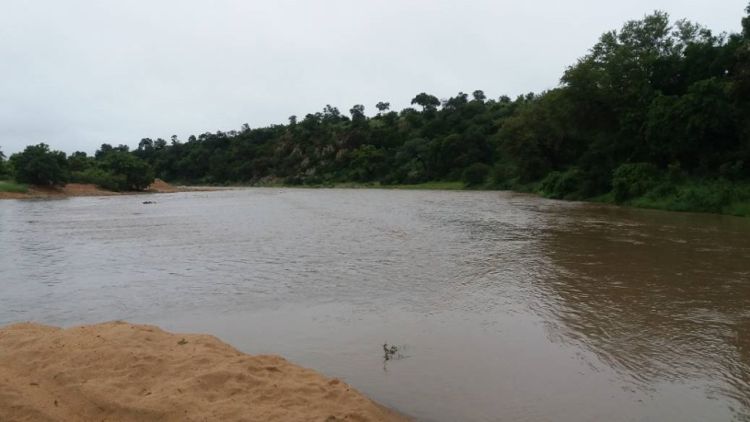
The confluence of the Nhlaralumi and Hammerkop Rivers on Buffelsbed
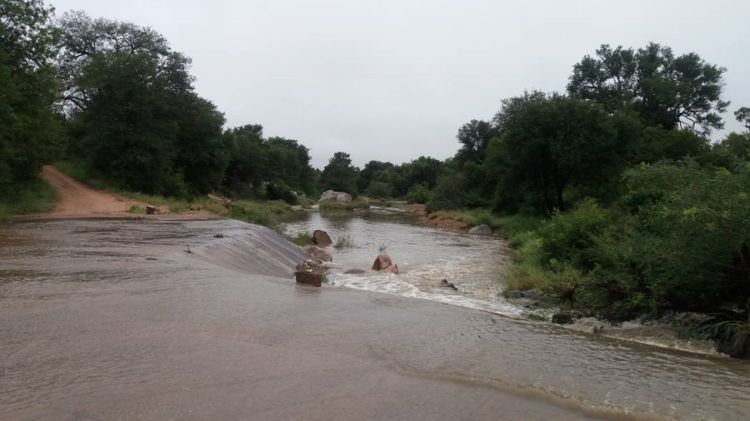
The Sekgobela River flowing

Tree frogs with their foam nests visible at most wallows
The cyclone Eloise brought back many memories of the 2012 Dando flood. It reminds us ecologically of how important it is to have free flowing rivers in open ecological systems where artificial impoundments in river courses should be limited as far as possible. I therefore share with the reader below, extracts from personal observations that were documented in 2014, post Dando 2012. In an ideal world allowing natural processes to take place would be best practice. I enjoyed reflecting back:
“The Nhlaralumi River system should be perennial, but with the upstream impoundments it became ephemeral. The recent failure of the dam has affected a reversion to a perennial system, and this is significant in many ways. Perennial systems provide an increased reliability of water and are thus more conducive to fauna and avifauna taking up residence (and not temporarily passing through). The impact of any small residual pools in the drainage system on the surrounding grazing vegetation is reduced as grazers do not need to frequent these sites when water is more readily available along the entire water course. In other words, there is no requirement for game to concentrate at artificial water points (or the few more persistent pools in the river) and impact negatively on available grazing. Natural water dispersal along a perennial river results in natural game dispersal and a low grazing pressure, resulting in an overall better veld condition, lower erosion, and lower management input requirements (such as burning). The riparian vegetation is benefitted by the perennial nature of the river in that it is able to establish and maintain better growth vigour for longer periods with the increased availability of water – and this growth vigour aids improved basal cover and tree/shrub establishment that better protects the riverbanks from soil erosion and occasional flooding impact.
Stagnant pools, formed in times of low flow, are flushed more frequently with clean oxygen rich water, rejuvenating the natural migration patterns for fish and other aquatic species. It is well known that dams create significant barriers to the natural functioning of rivers and impact negatively on natural patterns of species migration.
One of the most obvious changes in the Nhlaralumi is that without the dams the water table is maintained at a higher level (closer to the bed surface). This means that the river surface flows easier, more frequently, whereas in the past the dams would capture most of the natural run off from moderate storms and rainfall, and the river downstream of the impoundments would only flow every four or five years once all the upstream impoundments were full. Only the eventual overflowing of dams created water flow downstream. In a natural cycle this is erratic and unpredictable, and vastly detrimental to the long term survival of large trees associated with healthy riparian areas, such as Appel-leaf (Lonchocarpus capassa), Tamboti (Spirostachys africana), Figs (Ficus spp.), Leadwoods (Combretum imberbe), Weeping Boer Bean (Schotia brachypetala) and Acacia spp. Their current growth vigour has noticeably improved.
Good growth vigour of grass swards and grassy banks are now apparent, and this supports a healthier resident hippo population which can feed along the riparian zone creating hippo lawns, previously unknown on Ingwelala. There is a noticeable shift in the herbaceous and grass communities now providing for more plentiful palatable grass species, where previously the common species were forbs and grasses which were hardy and unpalatable. With the improved light penetration in the riparian zone and the rejuvenated trees there is a marked increase in broad leaf recruitment.
On any day you can find evidence of hippo everywhere, as many as nine individuals inhabiting Ingwelala, to the best of my knowledge a first, considering the previously water deprived river system.

Bird life has become much more prolific, especially those species associated with more permanent water bodies. Tangible examples are Spoonbills, Giant Kingfisher, Pied Kingfisher, Malachite Kingfisher, Brown-Hooded Kingfisher, Jacana, Hammerkop, Egyptian Geese, Saddle-billed Storks, Plovers and Sandpipers. Fish Eagles are seen daily, breading and resident throughout the year. Previously the Fish Eagles would track short term fish migration in the wet years and as the pools dried up, they would migrate away from Ingwelala. There appear to be a whole lot more bee-eaters (more prevalent due to water bodies producing higher insect biomass). Fish can migrate and the current biomass is sufficient to sustain the natural predation.

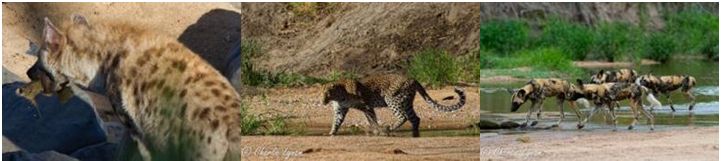
Hyenas, leopards, and wild dogs also predate on fish when conditions are favourable.
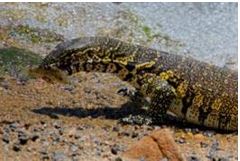
A monitor also fishing.
A further tangible example of a proper functioning river is a nesting female crocodile at Old Farmhouse. This exhibits suitable habitat for a prehistoric creature that was surely prolific in our area once upon a time.

In closing the subsequent rains recorded in 2013 and 2014 floods were significant enough to cause flooding in the Nhlaralumi River system. Without the upstream impoundments the observation made was that there seemed little threat that the river system would not cope with the volume of flow, therefore reducing the threat of damage to infrastructure. This was born out in the little damage caused by these flood events on Ingwelala – and no services or infrastructure were damaged.“
by John Llewellyn