


As we move towards summer and the wet season, we have placed extra emphasis on the treatment and removal of invasive plants both in camp and on the reserve.
This includes, but is not limited to, Prickly Pears (Opuntia spp.), Queen of the Night (Cereus jamacaru), Devil’s Rope (Cylindropuntia imbricata), Chandelier plant (Kalanchoe delagoensis), Mexican Poppy (Argemone mexicana) and Hummingbird tree (Sesbania grandiflora).
Over the course of five days, along with the assistance of a volunteer - Terry Pickard - we treated various species of cacti with biocontrol agents, and mechanically remove some smaller cacti, Mexican Poppies, Chandelier plants and Hummingbird trees on Argyle. With the exception of only a few roads, the vast majority of Argyle was scoured and treated for invasive plants, including some areas within the camp.
In total, Terry and Tessa managed to achieve the following:
- 3 Queen of the Night cacti treated with biocontrol agents
- 3 Devil’s Rope cacti treated with biocontrol agents
- 104 Prickly Pear cacti treated with biocontrol agents or mechanically removed, if small
- 18 Hummingbird trees mechanically removed
- 2 Chandelier plants mechanically removed
- 1,565 Mexican Poppies mechanically removed
Of the above, there are no known populations of Queen of the Night and Devil’s Rope cacti still to treat at this stage, however Prickly Pears and Mexican Poppies remain plentiful, along with various other invasive species - particularly in camp. Prickly Pear infestations tend to be found closer to riverbanks, while Mexican Poppy plants are mostly found along the length of the rivers, growing along the watercourse.
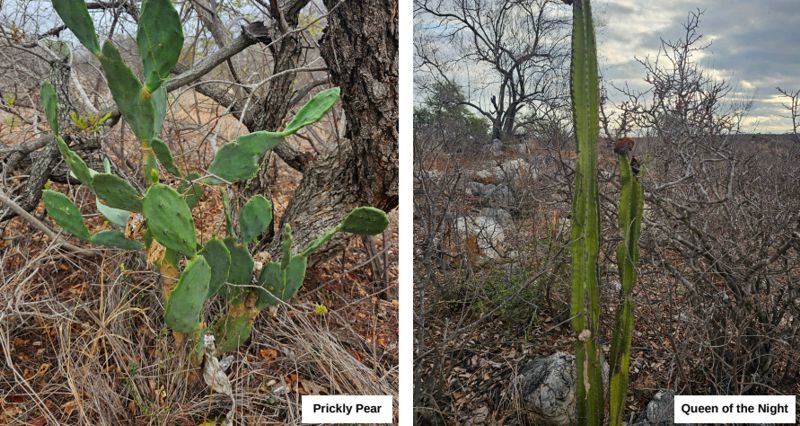
With temperatures rising, the populations of biocontrol agents that were introduced within the past 18 months have spiked, resulting in the perfect conditions for harvesting and introducing biocontrol agents for various invasive species. The biocontrol agents used differs, with two different species being manually introduced, harvested from previously treated specimens. For Prickly Pears, cochineal (Dactylopius opuntiae) is introduced. For Queen of the Night and Devil’s Rope cacti, mealybug (Hypogeococcu pungens) is introduced. Both biocontrol agents are natural enemies of the invasive cacti and have no known effect on any indigenous species, naturally dying off once the treated plant has died from treatment.
While invasive plant control is a constant and ongoing process, it is immensely helpful and productive when volunteers wish to join in the field and are particularly interested in making a visible and marked difference at Ingwelala. We would like to thank Terry Pickard for his incredible efforts in the field - he undoubtedly made a huge difference, and we look forward to the next session!

We take pride in being able to share what we do and find it incredibly enjoyable having people join us for some of our field work and conservation projects. Not only does this give us the opportunity to allow others to experience and enjoy the field work and diversity that conservation entails, but it also allows us to share ideas and thoughts with one another, create memories that leave a physical, lasting impression in our landscape, make more of a profound impact in what we do, and expand our mutual knowledge as we learn from each other in the field. There is certainly never a dull moment, and we always learn something new from each experience shared with volunteers.
Should you wish to join us in the field, whether to gain some experience within conservation, or for specific projects invasive plant control, reserve clean-up projects, tree protection, sightings monitoring or anything else, please feel free to contact Tessa at
Words by Tess Woollgar. Images courtesy of Tess Woollgar,