


A heavy focus for this month was Invasive/Alien Plant Control across the reserve.
We focused on the invasive cacti, although other species are present and will be dealt with in due course. The species we focused on were the Prickly Pears (various Opuntia species) and Queen of the Night (Cereus jamacaru).
This time around, we have switched control methods away from the norm and tried something different, which seems to be working spectacularly: biocontrol.
Biocontrol is the use of biological agents to naturally eradicate invasive species. This is done by manually introducing a biological agent onto the plant, which is a natural enemy of the invasive plant, and thus kills it over time.
The agents then die off and have no effect on native/indigenous species as they are host-specific to each species being controlled. We started the month by training five Conservation team members on how to correctly source and introduce the biocontrol agents, and then how to correctly record and monitor their progress.
This was then put into practice by actively sourcing and collecting the agents, and then introducing them onto various plants at Ingwelala. This process will be done with the entire team and form a base of continuity for how we eradicate these plants effectively in the future.
A massive thank you to Chris and Auriel Thorpe, and their colleagues Louis Mokoena and Prudence Mdau, for taking the time to upskill our team and assist us with sourcing, collecting, and introducing the correct agents for each species being controlled.
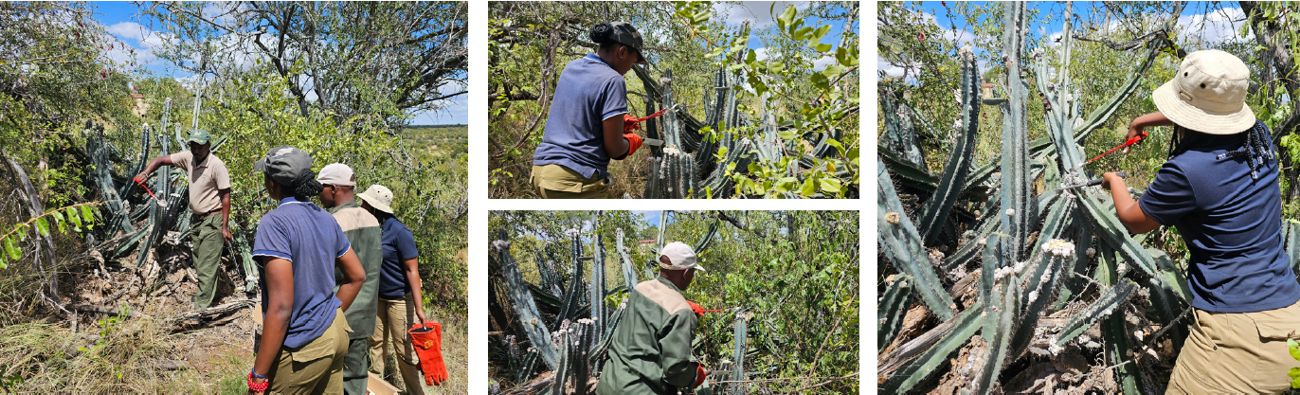 Some of the Conservation team undergoing training for invasive plant biocontrol
To expand on the biocontrol agents, and how the plants have been treated:
Prickly Pear (Opuntia spp.):
To control this plant, we use a biocontrol agent known as cochineal (Dactylopius opuntiae) - which some might know as the scale insect. It looks like a white fluffy growth on the outside of the flat pads of the cactus, but it is actually a nest of hundreds or thousands of tiny insects together. We use the Australian variant here, although it is also found in North America, India, and the Middle East.
To introduce the cochineal to a new plant to be treated, we simply remove an infested cladode (flat pad) of a Prickly Pear, and “peg” it to the plant we want to treat using wooden skewers. The insects then migrate onto the new plant, killing it over a period of 3-6 months and leaving behind a pile of what looks like ash where the plant used to be.
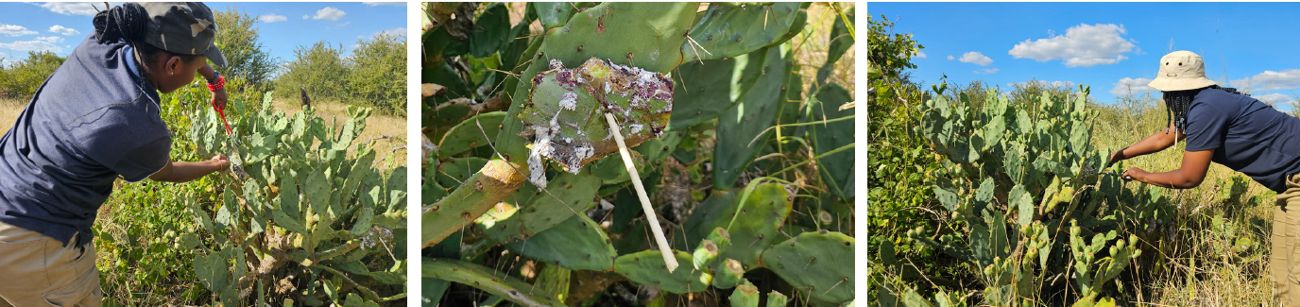 Treatment of Prickly Pear (Opuntia spp.) using Cochineal
Queen of the Night (Cereus jamacaru):
To control this plant, we use a biocontrol agent known as mealybugs (Hypogeococcus festerianus, now known as Hypogeococcus pungens) - which is very similar to cochineal. It looks like a white woolly mass or a white head of cauliflower at the growth tips and on the main stem of the cactus. Once again, we are using the Australian variant of mealybugs.
Similarly to the cochineal, to introduce the mealybugs to a new plant to be treated, we simply remove the masses of mealybugs from an infested Queen of the Night, and “peg” them to the plant we want to treat using wooden skewers. We also cut into the growth tips directly and place the mealybugs inside the tip of the plant. The insects then migrate onto the new plant, killing it over a period of 3-6 months, in the same way the cochineal would.
Using this method, over the course of the last month, over 40 invasive cacti have been treated with biocontrol agents on Argyle and in camp. Plants on Buffelsbed, Sibon and Op Goedehoop will be treated in the upcoming weeks/months. If you see the skewer sticks, please don’t remove them!
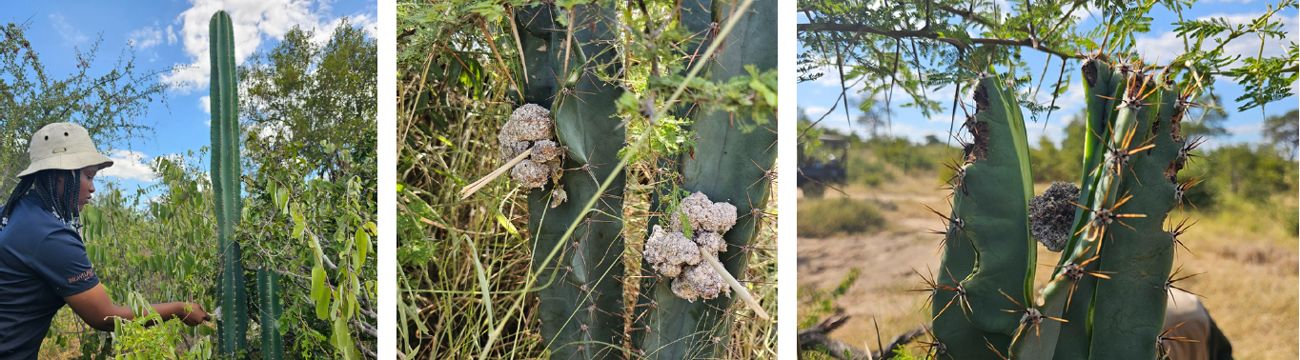 Treatment of Queen of the Night (Cereus jamacaru) using Mealybugs
In terms of other invasive species found on Ingwelala, we have a few main species we want to look at eradicating in the future. They are the yellow-flowered Mexican Poppy (Argemone mexicana), white-flowered Mexican Poppy (Argemone ochroleuca) and Hummingbird Tree (Sesbania grandiflora). All three of these species can be found along the riverbeds in particular, especially around Farmhouse Crossing and Combretum Crossing/Third Crossing.
The best way to eradicate all three species is manually removing them, although herbicides could also be used.
There are other species worth noting too, such as the Redstar Zinnia/Peruvian Zinnia (Zinnia peruviana) which has now been classified as a naturalised exotic, and thus is no longer evaluated for Red Lists in the country - even though it originally came from North and South America. These will not be removed, although we are interested to find out whether they spread further. These can be found near the base of Marula trees in more open areas, usually.
Another 2 species worth looking out for are the invasive Lantana’s (Lantana camara) and the non-invasive, but encroaching, Sickle bush (Dichrostachys cinerea). Both have the potential to overcrowd and completely out-compete native species, and we want to be on the lookout for these in case they pop up on the reserve.
Amazingly, we have not noted the presence of a single Lantana plant (which is impressive - they are incredibly populous in most areas) and have only noted 5 Sickle bush plants across the entirety of Ingwelala. For now, they will remain where they are, but should they start encroaching, we may need to look at controlling their numbers in the future. They are well known as one of the major native encroachers in the bushveld, so we’ll be keeping an eye on them to ensure that they don’t overcrowd the areas they are in. You can find one on River Loop, Argyle, and another at Buffels Hide, if you’re looking for them.
Words by Tess Woollgar, images courtesy of Tess Woollgar