


The continuation of the story from 19 May 2021 when Members in Bungalow #108 reported an injured Tawny Eagle with its legs entangled in wire.
It was decided to release the Tawny Eagle back into its natural habitat where he was first found injured with the following baseline facts:
Tawny Eagles (Aquila rapax), like other Eagle species, are diurnal – active by day, sleeping at night. Tawny Eagles tend to occupy the same territory for many years, sometimes even decades, in pairs, as they are known to be monogamous and pair for life.
Within the few months that the Tawny Eagle has been in rehabilitation, another Tawny Eagle has been noted within the same area and we hoped that it was his mate.
Tawny Eagles have great memories and by releasing it in the same area where it was found injured, it is his best chance of finding his mate, nest, and regain his territory after being absent for a few months.
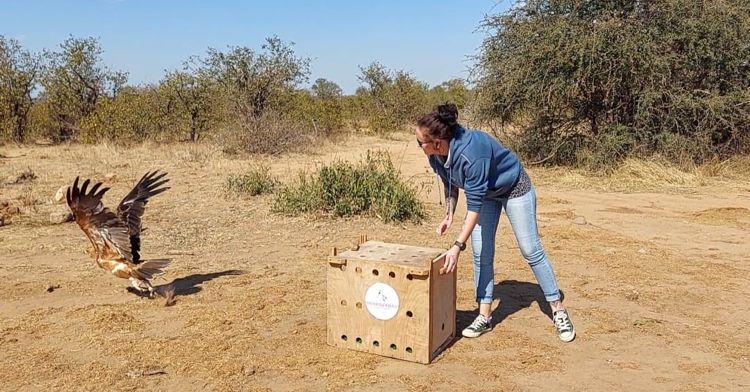
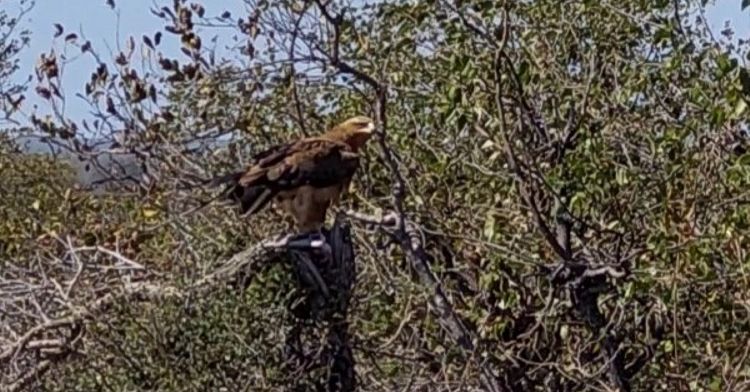
The release of the bird on 23 July 2021 was very successful and it immediately showed all the signs we were hoping for:
- It perched after taking off from the crate – (Great sign for needing to hunt and height visual)
- Flying circular orientation patterns and then flying off in a chosen direction.
For the interested bird watchers, this particular Tawny Eagle may be recognized in future by the way he perches. Although he has gained full function of both legs, he uses his left leg at an angle to perch due to tendon damage caused by the wire. He was not ringed or tagged because of this damage to his tendons, and there was a degree of concern that a ring around its leg may interfere with its new hunting technique. Researchers at Moholoholo Centre had the opportunity to observe the bird at close range over a period of time to ensure that it could hunt successfully by itself before allowing it to be released.
Like most Eagles, the Tawny Eagles are generalist carnivores and formidable hunters. Their diet includes fresh carrion of animals that have recently been killed. They also eat insects and kill small animals such as smaller birds, hares, and small reptiles including lizards and snakes. The Eagle will make a rapid dive from its perch when the prey is spotted, and seize it in its sharp, powerful talons.
As an opportunistic scavenger, the Tawny Eagle will also steal prey from other raptors. Birds that do this are known as ‘kleptoparasites’. These magnificent birds of prey can be observed alongside other large raptors, such as Vultures, ripping into carcasses.
Tawny Eagles are the only type of eagle that regularly scavenge from humans, and we may speculate that this is how he got injured.
Tawny Eagles do spend significant time near water where they can drink safely, and this is where it was initially located at Deadwood Pan.
Tawny Eagles breed once a year. Breeding season takes place from April to July. It may be to late this year for the monogamous bird pair to mate, but one can only hope they located each other soon after he was released.
Before mating occurs, the male Eagle performs undulating displays and then a mutual soaring display takes place in the air. The pair or the single male will perform high circular flying over the nesting site. Sometimes, the male performs ‘pot hooks’ which involves dives and swoops, with little wing flapping. The female may turn over and present her claws in response to the male swooping over her. The pair may lock claws in flight. Actual mating usually occurs at or near the nesting site.
The female Eagle lays 1 – 3 eggs in a nest made from sticks and twigs, either in trees, or, unusually on the ground. Both male and female take part in nest building. Nests are generally abandoned after 1 – 3 years in favour of a new location within their territorial range. The eggs hatch after being incubated by the female for 39 – 45 days. Incubation is occasionally done by the male.
Chicks become fledglings at around 84 days, and become independent at around 120 days, although some will remain with their parents until the following breeding season. The chicks are fed mainly by the male and then by both parents when the young become fledglings.
The life span of the Tawny Eagle is around 16 years. However, the oldest recorded Tawny Eagle living in the wild was 60 years.

Facts researched on the Internet. Words by Jodine Baard. Pictures courtesy of Walter Baard.