


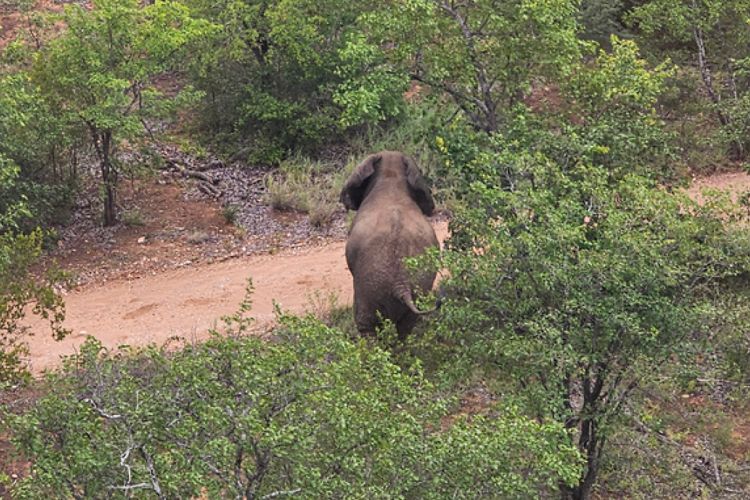
During the floods, five elephant bulls entered the camp in search of Marula fruits and a change of scenery.
The flooding had completely washed away all electric fencing at the river crossings surrounding the camp, and with the rivers still running high and the crossings inaccessible, there was no opportunity to install temporary barriers before the elephants made their way in.
Three younger bulls and two older bulls were noted inside the camp, and over the course of the month were all safely removed from camp using various techniques. These bulls came in by no fault of their own and caused very little damage in camp during their unexpected visit. There were only two incidents of a water supply line being broken, both of which were repaired quickly and easily, with no other noted incidents in that time.
In amongst the ongoing attempts to encourage them out of camp safely, temporary electric fencing was placed at the river crossings to discourage other elephants from entering, and to allow for quick removal when encouragement out of camp was ongoing. By this method, the three younger bulls exited camp through Giraffe Crossing, where the team stood by to immediately resurrect the temporary fence that had been opened to allow them safe passage during the encouragement process. Although a helicopter was required to assist with encouragement, the operation went smoothly and the fence was reinstated quickly thereafter.
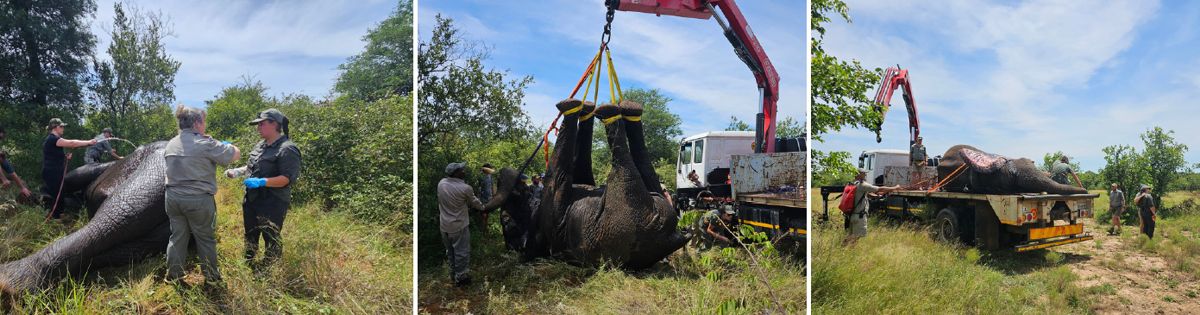
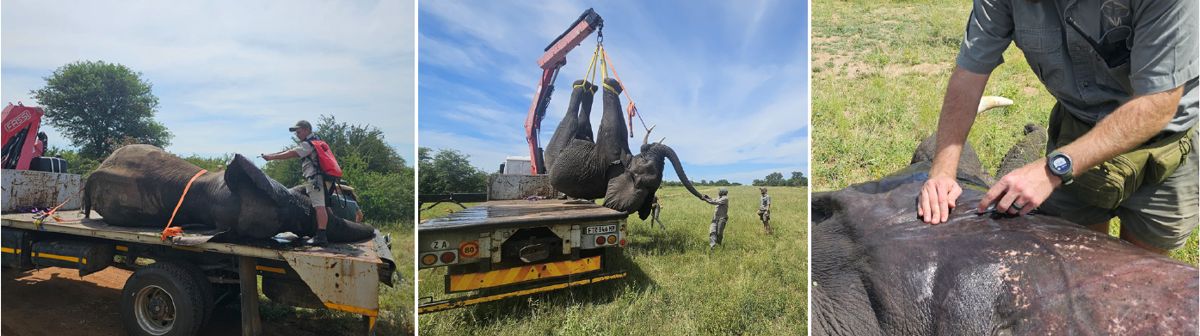
The two older bulls, however, who had a particular taste for the Marula fruits in camp, were not keen to vacate the area easily. After various attempts to encourage them out, both on the ground and with the assistance of a helicopter, it was decided that the best way forward would be to immobilise the bulls and remove them with a flat-bed truck, following which they would be relocated and safely released further afield within the UPNR.
Much to everyone’s surprise, both bulls were found in a favourable open area near the western fence line and immobilised within the first five minutes of flight-time! Members on site who wished to observe the operation and get closer to the immobilised bulls were able to join the team on the ground to witness the loading and relocation process off the second bull and enjoy some close-up time with him on the ground while he was immobilised.

The first bull was immobilised and loaded so smoothly and quickly that by the time Members arrived, he was already loaded up and safely on his way to his destination down the road. Luckily, Members still got to see him leaving on the truck, being cooled with water as he left!
The second bull presented a better opportunity for those Members, who were able to appreciate being on the ground with him while the truck and part of the ground team relocated the first bull. While both bulls were immobilised, Elephants Alive!, assisted by our conservation students Aimee and Tegan, were able to take samples from each bull to add to the existing database in our region. Samples taken for each bull included dung samples, blood samples, DNA samples and various body measurements.
Throughout the duration of the process, the veterinary team, assisted by Ingwelala ground staff, kept the bulls cool, monitored and safe while each was loaded and relocated. This included spraying the elephants with water to keep them cool, monitoring breathing and heart rate, cooling the load bed of the truck with water before loading the bulls, and constant monitoring and wetting during the relocation process. As far as relocation operations go, the team could not have asked for a more perfect execution when relocating these two bulls. Both bulls were safely released within the UPNR, having woken and walked off within seconds of being given the reversal agents by the veterinary team.
An enormous thanks go out to the amazing veterinary team at Wildlifevets.com - principal veterinarian Dr Chris Smith, veterinarian Dr Hayden Cuthill, veterinary nurse Olivia Searle, veterinary assistant Nkateko Matonsi, game capturer Louis van Wyk, and truck driver Sydney Malatjie - as well as local helicopter pilot, Jana Meyer, for all their expert and professional assistance with this successful relocation. We would also like to thank Josh Hibbett for his organisation of this operation on the ground, all Ingwelala staff who assisted with ground operations, and all Members who joined the field team on the day. A very special thanks goes out to all Members who contributed towards this successful operation to safely relocate these two bulls out of camp. Your generosity and willingness to contribute went a long way!
Lastly, a final thanks to N’tsiri Private Game Reserve and Ndlopfu Private Game Reserve for allowing access for our teams to release both bulls.
Words by Tess Woollgar. Images courtesy of Tess Woollgar & Josh Hibbett.