


With such unusual weather patterns recorded in the current season, there were some interesting observations made regarding various migratory bird species.
One such observation was the late departure of Woodland Kingfishers, which may depart as late as April, but in most seasons will depart during March. This year, there were Woodland Kingfishers present almost all the way through April - likely because of increased food availability, thanks to the extreme and extended rainfall. Although this is still within the “normal” date range, it is on the more extreme end of the spectrum.
There are countless bird species that spend their lives chasing summer - living in a world where winter is avoided by migrating across the globe. This is generally done in response to food availability, environmental conditions or breeding opportunities. As an example, in summer there is a higher availability of food due to more rainfall, and as such migratory birds follow summer, avoiding the harsh conditions of winter and finding better food sources at the same time. Some species migrate over shorter distances, some migrate sporadically or “randomly”, and others migrate over enormous distances, following set migration patterns that are centuries old. However, there are some species that do not migrate, and are resident species throughout the year.
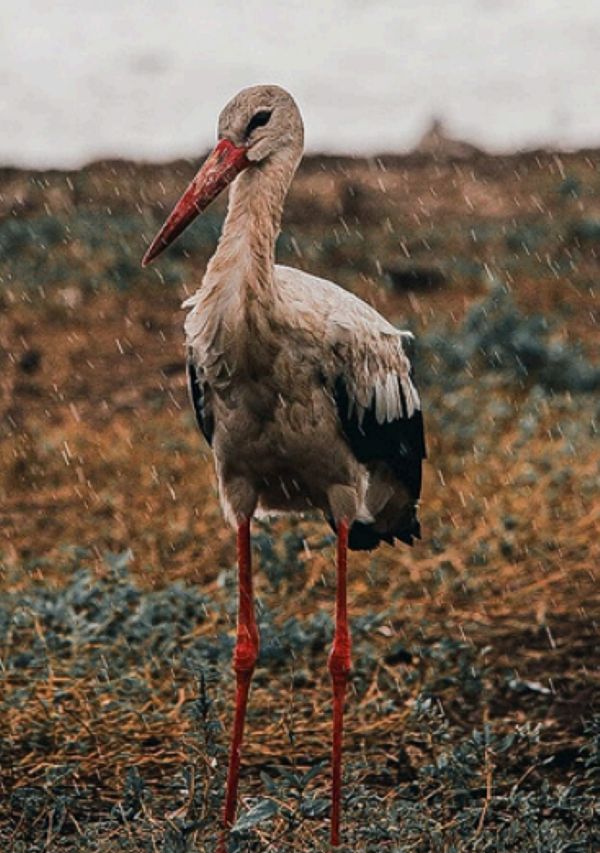
Migratory birds seen at Ingwelala can be split into two main types: palearctic and intra-African migrants. Palearctic migrants travel to South Africa from Europe, Asia, northern Africa and the Arabian Peninsula, and include species such as the waders, Wahlberg Eagle, Steppe Eagle, Common Buzzard, European Roller, European Bee-eater and Barn Swallow. Most of these species are insect-feeders and respond to the increased food availability in summer across the hemispheres, usually arriving in early spring. Intra-African migrants are species that migrate within Africa, following rainfall and often breeding in response to the rain. These species include the migratory cuckoos, Woodland Kingfisher, Yellow-billed Kite, Greater Striped Swallow and Southern Carmine Bee-eater. These birds often return to the same nesting sites used in years before, and usually arrive later in the year, closer to the first rains of the season.
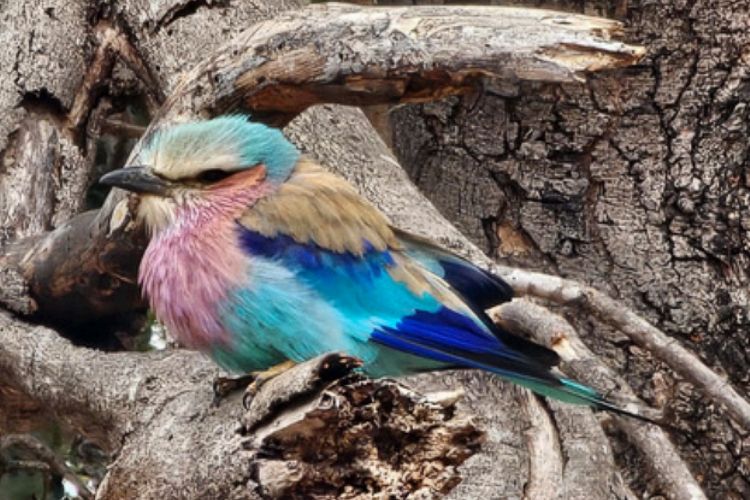
Over 100 migratory species have been recorded in South Africa, of which 44 species are palearctic migrants, and 35 are intra-African migrants. The rest are more sporadic in their migrations, and are usually seed-eaters, moving wherever the best food availability is at the time. Resident or non-migratory species such as the Lilac-breasted Roller, Burchell’s Coucal, Brown-headed Parrot and Tawny Eagle do not migrate at all and instead stay in a general area year-round. These birds often have a more diverse diet and have adapted well enough to the seasons and resource availability that there is no need to migrate.
During the times when migrants can be seen, resident species must share their habitat with those migrants - competing over food sources and nesting sites for the spring and summer months. The most noticeable interactions are often seen with European Rollers and Lilac-breasted Rollers, who will actively fight over food. Being similar in size, with a slight advantage on the side of the European Roller, these birds are known to be aggressive.
Interestingly, many people believe that they also compete for nesting sites, but this is not true. European Rollers are non-breeding migrants and arrive having already bred, usually in warm, dry areas in Morocco, Spain, Poland, Siberia or similar!
When looking at the migratory species at Ingwelala, the first species to arrive is usually the Yellow-billed Kite. What most people don’t know is that there are two types of migratory Yellow-billed Kites: non-breeding migrants (present between December and April), and breeding migrants (present from as early as July or August, departing in February or March). Breeding migrants occupy a territory as soon as they arrive, often using the same nest year after year, while non-breeding migrants tend to be nomadic and follow food availability. However, at Ingwelala most will arrive in August or September, followed closely by other species.
Without getting into too many specifics, there are important factors to consider for any migratory species, regardless of what type of migrant they are, or where they are coming from. All birds that migrate must be able to cope with travelling vast distances - sometimes tens of thousands of kilometres - and navigate accurately throughout. The most important adaptations and considerations for each bird include:
- Food availability: while some species may store excess fat to be used as energy before migrating, others rely solely on food along the way. This must be a strategic route, designed to follow and pass through areas with high food availability at the time they are flying over.
- Flight efficiency: a streamlined body and powerful muscles, along with light bones, allows migratory birds to fly for extended periods of time without landing. Conserving energy using thermal vents or wind is also to be considered.
- Physiology: during migrations, birds undergo physiological changes, including changes in hormone levels and enzyme activity to make them stronger, fitter and more efficient.
- Navigation: while routes may be centuries old, each bird must notice environmental cues, innate behaviours, direction, navigational markers and more to find their way to their destination. Birds may use the sun, magnetic fields, landmarks or even starts to assist with orientation during these long journeys. Much of this journey becomes memory, too!
Unfortunately, this also means migratory birds are at severe risk when en-route. Some threats include:
- Severe weather changes (e.g. cold, storms, strong winds, extended rainfall) which may kill, injure or weaken birds, or may blow them far off course. Cold weather can also cause illness.
- Starvation is a real possibility, as the birds must find enough food en-route to have enough energy to continue in either direction.
- Habitat loss along the way or at either destination, which results in decreased food and shelter availability.
- Predation and collisions when birds are weak or tired.
- Human-related activities in areas used during migrations, or at either destination.
Considering the above, and with current climatic changes, it will be interesting to see how migratory birds react as the season comes to an end and another begins. Although more rainfall may be beneficial, it may also be too much and can have severe knock-on effects. Unfortunately, only time will tell what changes may come.
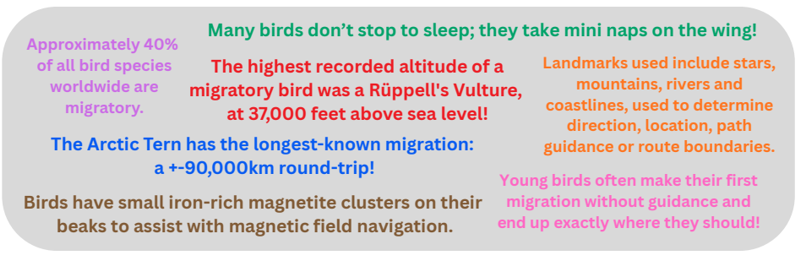
Despite that, bird migrations are some of the most incredible adaptations on the planet. Here are some interesting facts:
Words by Tess Woolgar. Images courtesy of Josh Hibbett and Tess Woollgar