


The December Reserve Report is a time to reflect on the life at Ingwelala over the past twelve months, the highs, the lows, the special achievements, and the necessary acknowledgements within the community.
2020 came with its unprecedented social, economic and lifestyle changes brought about by the global pandemic Covid – 19. At a time of reflection I ask the reader to take a quiet moment to remember all those, who with great sadness, succumbed to this disease. The hope that 2021 will deliver an efficient and humanitarian roll out plan to vaccinate against the decease is an action that will hopefully provide some light at the end of the tunnel.
The Ingwelala Board was instrumental in its leadership and response to the pandemic and the effect it had in the workplace and in turn the operational functioning of Ingwelala, its economic challenges and ultimate survival as a community. The work pressures at Board level continued unabated with key items such as the Umbabat MOI and Code of Conduct, Annual Budget, Municipal Rates and Taxes, Insurance renewal, Risk analysis, and Annual financial audit all attended to with due diligence. Sincere gratitude is expressed to the non-executive Directors who voluntarily serve on the Board, unselfishly giving up personal time and resources to get the job done. A special thank you to Belinda Scott, Charl du Plessis, and Darrell Caister for their contribution as Directors over the past years, and a warm welcome to Archie Rutherford, Deborah O’Connor, Christo de Vos, and Paul Marsh who were recently elected to the Ingwelala Board. May the years ahead be an enjoyable and productive work environment for you, with plenty of successes to come.
The staff are thanked for their understanding and patience and response through the various national Lockdown levels imposed since 26 March 2020. The general standard of mask wearing, sanitizing and social distancing exhibited by the staff as been outstanding in the workplace. The employment contract with Andre and Daphne Strydom ended in November 2020 when Andre reached normal retirement age. On behalf of the entire Ingwelala community, thank you, Andre and Daphne for the time you joined us on our work journey, for your invaluable contribution, your wonderful skill sets, your loyalty, and commitment, and for always going the extra mile to serve with distinction. We wish Andre and Daphne the best of luck with their new venture at Ntsiri.
The Covid restrictions on public gatherings and the timing thereof largely prohibited the opportunity to hold the traditional Member Information Meetings. Thanks to social media platforms like Zoom, it was possible for Members to attend a presentation by Kyle Middleton, held via Zoom, on the Ground Hornbill research work being carried out in the Greater Kruger. The presentation was well received. Interestingly enough, many Members chose to attend the November AGM via Zoom as well, feedback on the use of this media platform was extremely positive.
During the year under review, the monthly Reserve Reports included several education articles, including:
- Black Backed Jackal (Canis mesomelas)
- Bushbuck (Tragelaphus scriptus)
- Warthog (Phacochoerus africanus)
- Pied Kingfisher (Ceryle rudis)
- Banded Mongoose (Mungos mungo)
- Freshwater mussel (spp)
- Double-banded Sandgrouse (Pterocles bicinctus)
- Klipspringer (Oreotragus oreotragus)
- Caracal (Caracal caracal)
- African Wild Dog (Lycaon pictus)
- Fireflies (Family Lampyridae)
- Baobab Tree (Adansonia digitata)
The Nhlaralumi and Sekgobela Rivers flowed in January and February 2020, the concrete causeway in camp crossing the Sekgobela River suffered some damage when the Sekgobela flowed with force. The Hammerkop River flowed in January 2020.

Damage to the Sekgobela Causeway
Of special interest in January 2020 was a sighting of two eland (Taurotragus oryx) seen in the south western part of Argyle. The two eland were later seen on Ndlopfu, Gail Kelly kindly provided the picture below.
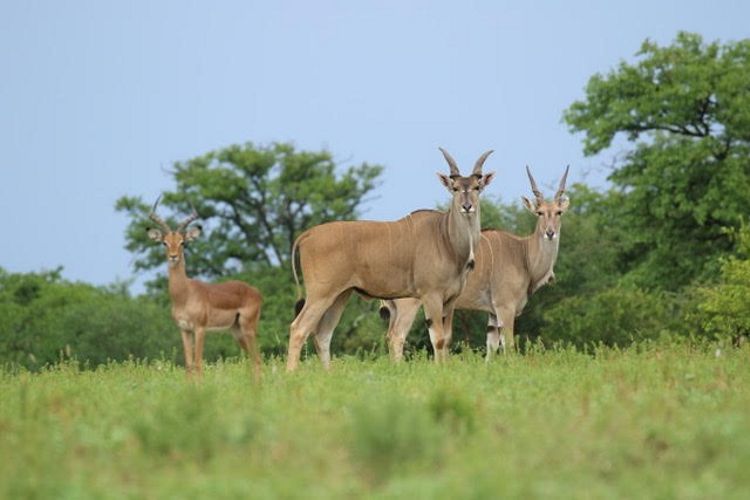
Eland (Taurotragus oryx)
Wildlife movement and behaviour were described in detail in the monthly reserve reports published during strict Lockdown levels 5 and 4, the June 2020 Reserve Report recorded as follows:
“Reflecting on the observations of Chris Mayes, and the challenges his Conservation Team face managing elephants 24/7, if I may indulge the reader with a few of my own observations? My interpretation and theories around some of the animal behaviour (during Lockdown) are my personal opinions and have no scientific basis or backing.
- To me, elephants, were the first to potentially show a change in behaviour. The sudden dilution of human presence, the near absence of vehicular movement, noise impact, light impact, all the elements that make up the “human barrier” that normally keep wildlife at an arm’s distance, seemed to soften. The presence of a breeding herd, with noticeably young calves, taking up residence in camp for several weeks on end, is not a behavioural trait that I would ever have predicted. There was no aggression from these elephants, the few humans inhabiting camp kept a respectful distance, the elephants were calm.
The bulls that frequented camp painted a different picture. Their behaviour was typical of youthfulness intent on making a statement. The feeding was destructive and wasteful, pushing over trees in a show of physical prowess, even dead trees and dead tree trunks annihilated. Why? My theory is these are bulls trying to establish their position and rank in elephant society, and within the macro elephant population, the size of the camp is large enough to create a micro population for these handful of bulls to establish their so called pecking order amongst each other.
The sand seal road became strewn with elephant dung, an exponential increase in activity of movement and feeding along the road with such little vehicular movement, a result of the human barrier once again diluted, when usually elephants spend less time in this zone? - Spotted hyenas appeared to more brazen, increasing their foraging hours to well before dark and well after dawn. They seemed to be more vocal and fight with each other more frequently. Were these battles territorial based between clans or simply a review of social hierarchy within the resident clan? Were the extended foraging hours a result of fewer opportunistic scraps available from indirect human feeding? There were confirmed reports of hyenas entering dwellings! Fewer humans, braver hyenas?
- Perhaps not initially, but as the Lockdown progressed, leopard activity undoubtedly increased in the camp environment. Busy human areas usually avoided by these secretive and retiring predators became tranquil spaces, a sort of “no man’s land” if you like where no more did one species dominate or hold the upper hand (except for elephants!). This seemed to afford the leopards a sense of space where they could explore and spend time in areas they usually only pass through.
- The birds too, early on, very vocal as they went about their business, a cacophony of chirpy sounds. Were we hearing their contribution more clearly for the first time due to the sudden void of an ever present human hum in the background?”
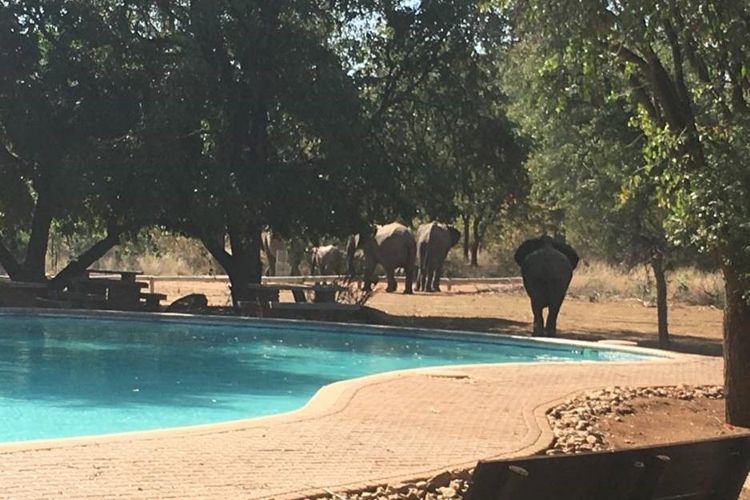
Breeding herd of elephants inhabiting camp
The challenge to curb elephant bulls breaching the camp electric fence is ongoing. This topic received a considerable amount of airtime and debate within the community, especially around the configuration of a Board approved trial fence. It culminated in suspension of the trial fence with a “Task Team” appointed, under the leadership of Deborah O/Connor, the current Environmental Director, to recommend a solution to the Board. This remains work in progress.
The Hides & Bomas and Picnic Sites received a major “spring clean” during Lockdown level 5, the facilities enjoyed by many Members when the Reserve was re-opened according to Covid – 19 regulations. What ensued were four consecutive record months of numbers of visitors to the Reserve.

Motswari Corner
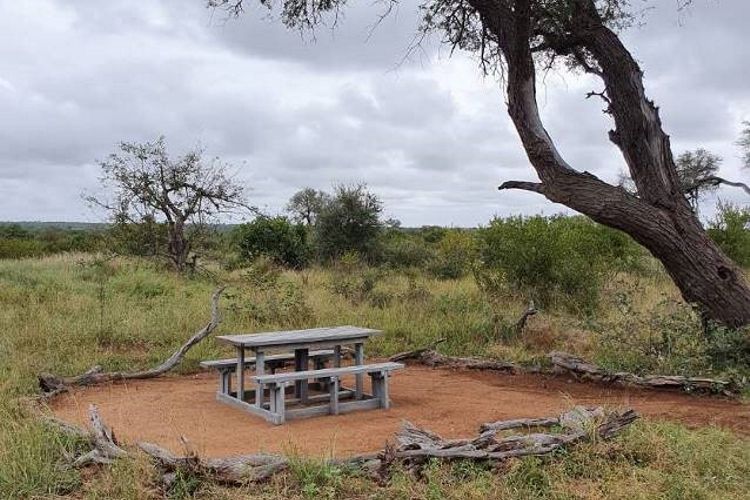
Sunset Pause
The solar pump installation has been completed at #5 borehole to the west of Deadwood pan. Concrete pyramid packing has been completed around the base of the installation to deter any elephant impact.
Last but not least, for 2020, was the passing of the remaining company tracking dog, Bill. The July Reserve Report read:
“At the time of finalising this report, it is with great sadness we say good-bye to the remaining company dog, Bill, who passed suddenly from a ruptured spleen, induced by a malignant tumour. There is some comfort that his passing was without a long suffering illness.
Bill survived his brother, Max, (same litter) who died from Tick Bite Fever in May 2019. The two brothers were born on 06 June 2009. The need to train and deploy two tracker dogs at that time was due to a scourge of theft of solar panels and security related matters. The dogs performed in their duties exceptionally well, their unprecedented obedience and loyal service to the company paid significant economic dividends. Their mere presence and habitual successes on the track were sufficient to second guess end any mischievous behaviour in the minds of perpetrators. A job well done!

Bill (left) and Max: Three months old
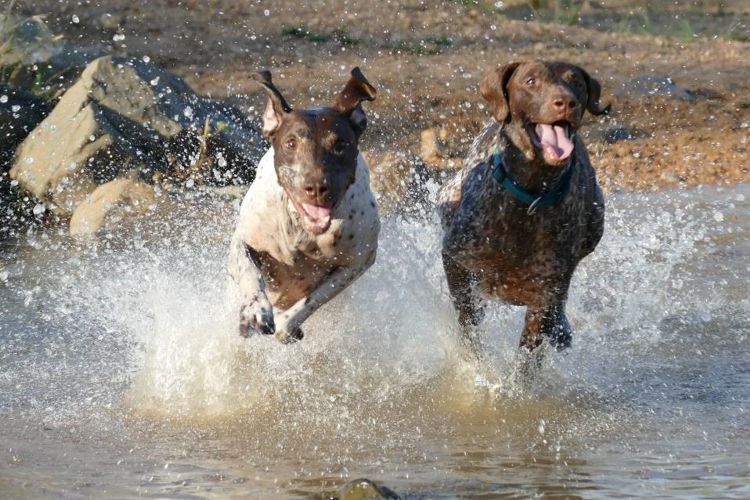
Exercising in the river – what they loved most

A pensive moment
In closing there are several staff acknowledgements that went into the management, welfare, and full time care of the dogs, given the extreme summer temperatures, the ever presence of venomous snakes, and the predatory nature of leopards and hyenas. There was a massive effort that went into ensuring the dogs were never a “nuisance” factor in camp with unscrupulous barking detracting from the natural experience one expects to find in wild areas.
In this regard I thank Sibongile, Surprise, Hendrinah and Covey in Housekeeping who did their fair share of day-time supervision whilst the dogs were home in their yards. During these past 11 years, thanks go to past and present supervisory staff Pieter & Annemie, Heinz& Maryna, Robere & Judy, Andre & Daphne, and Mark & Karen, who all made their homes available to achieve a common goal in the best interests of the company and its general security.
Thatch Risk Acceptances (TRA), our current Insurer, sponsored the security dog, Stormy, (Mark Shaw was the handler), is also acknowledged for its generous support towards wildlife security”.
by John Llewellyn