


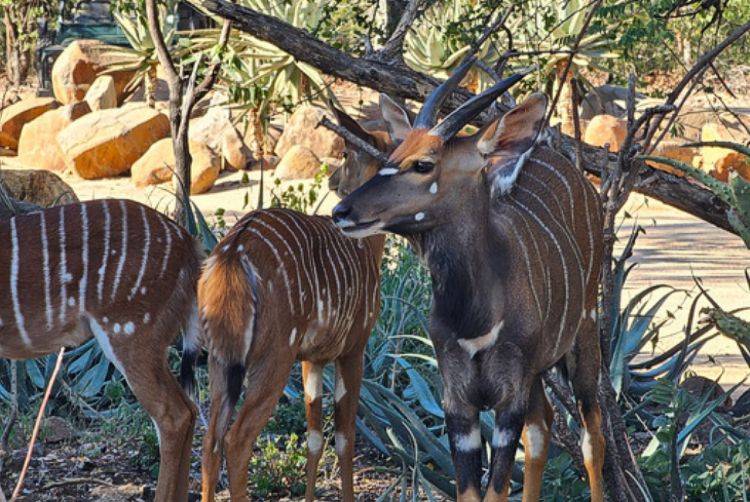
The graceful nyala (Tragelaphus angasii) is possibly the most distinctive antelope that occurs at Ingwelala.
With extremely striking coat markings, and a stark difference between males and females, this antelope is almost guaranteed to catch your attention. Nyalas are most commonly found in dense woodland and riverine thickets - making it a particularly common species in camp - and are known to become easily habituated to the presence of humans.
In general, nyalas have distinctive, white vertical stripes along the length of the body, with occasional white spots. These markings form part of their camouflage, to blend into dense woodland habitats in amongst trees and brush. They also have a white chevron below the eyes, on the bridge of the nose, and very fluffy, white under-tails. This, however, is where the similarities between males and females end. Nyalas exhibit extreme sexual dimorphism, with adults of each sex looking so different, and having such substantial differences in weight, that they may be mistaken for entirely different species.
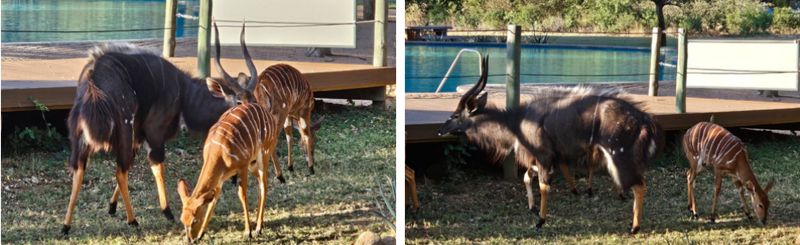
Adult males are disproportionately larger than females, weighing up to 120kg, while females are almost half that size, generally weighing up to 65kg at most. Mature males are a deep charcoal grey, with a long, shaggy beard and a distinctive black and grey mane along the length of the back. The legs have “long sock” patterning, with reddish-brown lower legs ending in prominent white spots above the knee. Females are uniform reddish-brown in colour across the entire body, with more prominent white stripes and spots evident. Females lack horns, while mature males have long, spiralled horns.
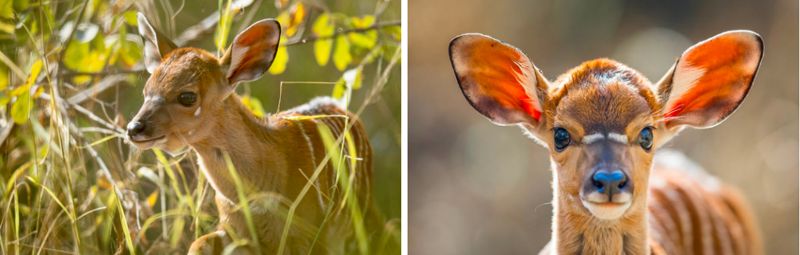
Interestingly, when lambs are born, they resemble the ewes, regardless of sex. This is both for camouflaging the lambs, and to assist with avoiding male-specific aggression, as mature males can be very competitive. If young males looked like mature males, they would be subjected to that competition from an early age, before they may have had the opportunity to fully develop and begin to mature. Young male nyalas only begin to show colour changes at 18 months old, usually beginning with the dark mane stripe and beard, and will only fully develop mature male colouration when they reach sexual maturity at four years old. Females do not change colour at all and reach sexual maturity at one year old.
The name “nyala” comes from local languages, such as isiZulu (“inxala”) or xiTsonga (“inyala”), which are a nod to the shy and cautious nature of the antelope. Scientifically, the genus name Tragelaphus is derived from the Greek words “trágos” (“he-goat”) and “élaphus” (deer or stag) - which loosely translates to “goat-deer” in the full word - likely in reference to the shaggy beard and spiralled horns present in males of the species in this genus.
Other species in this genus include Giant Eland, Common Eland, Greater Kudu, Lesser Kudu, Bongo, Sitatunga, Mountain Nyala, Northern Bushbuck, and Cape Bushbuck.
Did you know?
- Nyalas are unique in that their sex-specific terminology does not match like it would in other species. They form the “benchmark” species of antelopes for sex-specific classification: because the weight difference between males and females is so stark, males are classified as bulls, but females are classified as ewes instead of cows. When extrapolated to other antelope species, any antelopes the same weight or heavier than a nyala bull will be classified as bulls, cows and calves, while any antelopes the same weight or lighter than a nyala ewe will be classified as rams, ewes and lambs. Hence, a kudu would be a bull, cow or calf, while an impala would be a ram, ewe or lamb. These sex-specific classifications are based on weight, not size.
Fun Fact:
- Male nyalas perform drawn-out dominance displays to outcompete other males, and to impress females in the herd. Males will size each other up by lowering their heads, erecting their manes, and circling each other, while strutting incredibly slowly, to display size, strength and dominance. This can last hours, and if need be, aggressive fights break out between males. The winner may try to mate with females, who must also be courted, to allow mating to happen.
- Nyalas are known to follow other animals, such as baboons and monkeys, while they are feeding, to be able to access foods that would otherwise be more difficult to come by. This includes fruits, flowers and leaves that other animals may drop or cause to fall to the floor from the canopies of trees, and may also include hard foods such as sausage fruits, which baboons can easily open with their teeth, but nyalas cannot. The baboons and monkeys also act as an early detection system for predators - particularly leopards - in dense habitats. However, baboons have also been known to prey on nyala lambs, so the nyalas must still be alert and careful in their presence - especially if they have young lambs with them.
- Nyalas are somewhat unusual in their behaviours: while most antelopes would prefer to jump over obstacles, nyalas are known to also climb underneath them. This is likely due to their favoured habitats being dense, allowing them to hide easily and find comfort in hiding underneath dense shrubbery. This also conforms with their preferred method of avoiding predation, called the “freeze and fade” method. When a predator is detected close by, nyalas will freeze in the closest cover, using their camouflage to blend in with the environment. When they feel they can move, they slowly move to shrubbery further away from the perceived threat, once again freezing in the new cover. However, this does not mean they cannot and will not jump over obstacles or flee at speed when necessary. Nyalas are capable of impressive speeds, and can jump over obstacles like fences with ease, should it be required.
- To assist with predator avoidance in the dense habitats they prefer, nyalas also walk with a “direct register”. When they walk, nyalas take extreme care to make sure that the back foot is placed directly in the footprint of the front foot that was placed down first. This is to ensure that they can walk as quietly as possible, as the dead twigs and leaves on the ground may alert predators to their presence when stepped on. This careful placement of each hoof ensures as little noise is made as possible, and, in theory, almost halves the noise made when walking.
Words by Tess Woollgar. Images courtesy of Terry Pickard and Tessa Woollgar.