


When I decided on the topic of grasses it was very difficult to decide on a subject heading regarding the topic as grasses is such a diverse, scientifically based, factual, boring, and comprehensive subject.
Today when we read about grasses it is all scientific based and one should understand why.
It is where it all begins. All scientific research starts at the beginning, and the beginning is grass. My idea to this report is to rather tell a story on the subject that grass is considered as probably the lowest part of the food chain, yet no life would exist without grass. It is the most vital staple diet for both human and animal consumption.
Grass is different things to different people. The crop farmer will say that it is a weed. The livestock farmer will say it is food to his cattle. A child will say it’s something to play on. Most people will say grass is … well, just grass.
The grass family is the fifth largest plant family on earth. There are some 9700 grass species on earth, of which about a tenth (976 species) occur in Southern Africa.
South Africa is exceptionally rich in palatable grasses and serves as grazing to life/wildlife.
The bushveld and especially the Timbavati area is in the transition zone of the Eastern mixed bushveld and the Transvaal sweet bushveld.
The Eastern mixed bushveld is classified as the hot lowveld of Mpumalanga. Rainfall ranges 625 – 700mm/annum, but high evaporative rates reduce the efficiency of this rainfall considerably. The tree components range from sparse to dense. The grass veld forming the ground layer is tall, and is dominated by T. triandra, P. maximum, and provides extremely useful grazing. Overgrazing causes Eragrostis species, S. pappophoroides, A. congesta, A. bipartita to become prominent. Only the last of these provides useful grazing. Forbes are also a common feature of this veld.
The Transvaal sweet bushveld type is found in the low-lying areas of Limpopo valley, where the climate is warm and relatively dry. The rainfall ranges from 300 – 500mm/annum. The tree component also ranges from sparse to dense and can be dominated by the Mopane veld. The herbaceous layer is also extremely variable. In good condition it is characterized by an abundance of species such as P. maximum, P. colaratum, D. eriantha, Anthephora pubescens and T. triandra. And much more other common species can be listed.
In South Africa the season of use of veld is described by using the terms sweet, mixed, and sour veld. By definition, sweetveld is a veld which remains palatable and nutritious when it is mature, whereas sourveld provides palatable material only during the growing season (Scott 1947). Mixed veld is intermediate between these two extremes, and ranges from sweet-mixed veld, which provides grazing for about 9 – 11 months of the year, to sour-mixed veld, which provides grazing for 6 – 8 months. In general, the distinction between sweetveld and sourveld is reasonably clear in the summer rainfall regions. Here growth is in any event restricted to the spring and summer season, and the subtropical grass species which dominate the grasslands in these areas all mature in mid- to late summer. Sourveld is therefore grazeable in spring and summer and becomes unpalatable to stock in autumn.
A number of other characteristics associated with the season of use of grassveld may help identify the degree of sweetness or sourness of the veld.
As in the picture below it shows that our area is classified in the sweetveld distribution but may have some mixedveld characteristics.

Sweetveld characteristically occurs in areas with low rainfall and mild winters. The soil has a high fertility status due to the little leaching associated with a low rainfall. The grass therefore grows in fertile soil; it is palatable; and has a high nutritional value. In addition, little nutrients are stored in the roots during the mild winters and the grass is therefore even palatable in the winter. Due to its high palatability, sweetveld is easily overgrazed, however.
Grasses are exceptionally well adapted to defoliation and have probably been subject to defoliation for the past 20 million years when grazers started to evolve. The growth points of the grass plant are situated at or very close to the ground level, out of reach of the grazing animal. Furthermore, grasses can store reserve nutrients in their roots and culm bases and use them later for regrowth.
A grass species is well adapted to specific growth conditions and its numbers will diminish if these conditions change. The sensitivity to specific conditions makes grasses good indicators of the veld condition. For this reason, grasses are often used in methods to determine the condition of the veld, and make use of this information for any veld management decisions such as the following: Grass management; Veld fires; Soil erosion; Grazing; Plant succession; Identification; Forage quality; Veld condition assessment; Bush encroachment; etc.
Southern Africa is particularly blessed with the amount of good grazing grasses which occur naturally in the region. The establishment and management of cultivated pastures, veld management and baseline information are a highly specialized industry. Yet, it was difficult writing a story that would keep the interest of the readers and provide educational knowledge for a better understanding to the topic. Grass and the ecology surrounding grasses is such a vast and complex system that it is difficult to keep the topic simple and basic.
When one does further research regarding grasses, one will grasp the importance of this species and how we underestimate the value of these highly important species every day.
To note: Grasses are so important that wars have been fought over it and for the use of this valuable resource. Whether it is grazing for cattle or crops for human consumption.
If you think about it: rice, maize, sorghum, sugar cane, etc. These are all grass species and if they cease to exist the implications on humanity would be truly catastrophic, and this excludes the species that are vital for the continued existence of animals which is still the most readily available source of protein for humans.
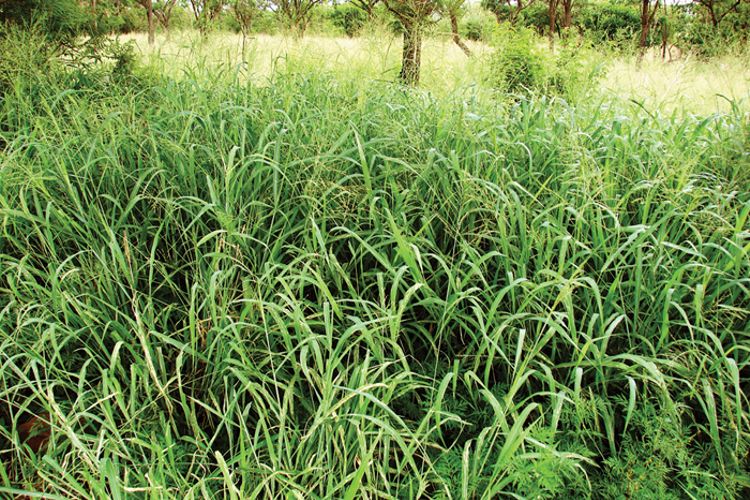
P. maximum

Eragrostis
Written by: Jo Baard
Research: Internet based
Book: Veld Management in South Africa edited by Neil Tainton.
.